
Cartier Holds Its Value. It Is Not an Investment.
Cartier is the brand most people picture when they hear “fine jewelry.” Or they don’t even realize they do, it’s been around that long. 178 years old, owned by the Swiss luxury group Richemont (the same parent company that owns Van Cleef & Arpels and Buccellati), worn on pretty much every red carpet for the last sixty years, with a Fifth Avenue boutique that runs a wait list and a back catalog of pieces that have appeared in far more films than most working actors. The story behind that stature is deeper than you know. Cartier has built nearly its entire modern jewelry catalog around four shapes: a bracelet ringed with screws, a nail bent into a wrist cuff, three interlocking bands of gold, and a panther’s head. The House of Cartier has refused for over a hundred years to let any of them lose their meaning.
Take the bracelet with the screws. Love. When the Italian-American designer Aldo Cipullo designed the Love in Cartier’s New York studio in 1969, he gave it a small flathead screwdriver and one rule. You couldn’t put it on or take it off without someone else’s help. The piece was meant to be worn by a couple, sealed and unsealed in turns, and the screwdriver was the point. You wore the bracelet because you trusted somebody enough to hand them the screwdriver. Six decades later it is the most photographed fine jewelry design in the world. Almost nobody talks about the screwdriver anymore, the screwdriver is now table stakes.
The bigger question of value is a deeper debate. Does Cartier jewelry appreciate in value? Well, it does and it doesn’t, and the gap between those two answers is what you might be here to find out. Cartier holds its value better than any other brand in fine jewelry. It is also not, in dollars only, a great investment. It is definitely a great investment in social capital. Both are true, they do not contradict each other. The math behind the gap surprises buyers who walk in believing the marketing, and so do a few of the brand’s lesser-known rules: the limit on how many times a piece can be polished, the database that authenticates every Cartier the boutique has ever sold, the cadence of price increases that nobody announces in advance. The story Cartier tells about itself is loud, it has to be to carry the history. The story behind it is quieter and more interesting.
How the house was built
Cartier was founded in 1847 in Paris by Louis-François Cartier, a twenty-eight-year-old jeweler who had just taken over his master’s workshop. For its first half-century the firm was a small Paris operation that did fine work but had no global presence.
What changed it was the family deciding, in the 1890s, that one workshop in Paris was not enough. In 1899 Louis-François’s grandson Louis Cartier moved the company to 13 rue de la Paix, the address that still stands as the brand’s spiritual home. He and his two brothers then split the rest of the world. Louis kept Paris. Pierre took New York and opened the Fifth Avenue boutique in 1909. Jacques took London and opened on New Bond Street the same year. Within a decade Cartier had royal warrants from the courts of England, Russia, Spain, Portugal, Siam, and a half-dozen others. Edward VII of England, ordering twenty-seven tiaras for his coronation, called the firm “the jeweller of kings, and the king of jewellers.” The line stuck because it was true. It’s good shit, and there’s no denying it.
The brand’s deepest authority comes from the forty years that followed, roughly 1900 to 1947, when Cartier became the jeweler the Indian princely states sent their stones to. Jacques Cartier booked passage to India in 1911 for the Delhi Durbar, the coronation event for King George V as Emperor of India, and came back to London with trunks of carved Indian gems and a customer list of maharajas. Within a decade Cartier was the working jeweler for the courts of Patiala, Indore, Kapurthala, Nawanagar, and a half-dozen others. An Indian prince would arrive in Paris with chests of family stones, and Cartier would reset them in platinum, in art-deco settings he could wear in Europe. The biggest commission was Maharaja Bhupinder Singh of Patiala’s: by 1928 Cartier had used his stones to build the Patiala Necklace, with five platinum chains, 2,930 diamonds, and a center pendant holding the 234.65-carat De Beers yellow diamond, the seventh-largest faceted diamond in the world. The necklace disappeared during partition in 1948 and most of it has never been recovered. Cartier reconstructed a working replica in 2002.
The era’s pieces are spectacular and also a record of European jewelers acquiring Indian craft at a moment when colonial dynamics let it happen on uneven terms. Many of the maharajas’ original pieces were broken up and reset; some of the carvings were centuries-old Indian work that no longer exists in its original form. Jewelry historians have written about this since the 1990s. The Tutti Frutti style, named in the 1970s for the dense floral arrangements of carved Indian gems, became Cartier’s high-jewelry signature, and pieces from this era routinely run into the seven figures at auction.
The modern catalog was designed in those same studios. Louis designed the Santos in 1904 for the aviator Alberto Santos-Dumont, and effectively invented the men’s wristwatch. The Tank followed in 1917, Trinity in 1924. Jeanne Toussaint took over the jewelry department in 1933 and ran it for thirty-seven years, turning the panther from one motif among many into a brand-defining signature. Aldo Cipullo, working out of Pierre’s New York studio, designed the Love in 1969 and the Juste un Clou in 1971.
The family’s grip on the firm began to slip after Louis died in 1942. The three city operations merged in the 1960s, then changed hands across the 1970s under financial pressure. Robert Hocq and Joseph Kanoui consolidated the brand as “Cartier Monde” in 1972 and ran it through the Les Must de Cartier years. The Vendôme Group acquired the house in 1988, and Vendôme rolled into Richemont in the late 1990s. The Cartiers themselves are no longer in the building. The four shapes survived the changeover unaltered. You’d be crazy to kill the golden geese.
The classics
Each of the four shapes came out of a specific room at a specific moment, and each one has been kept on the catalog since with only the lightest hand on the design. Trinity first.
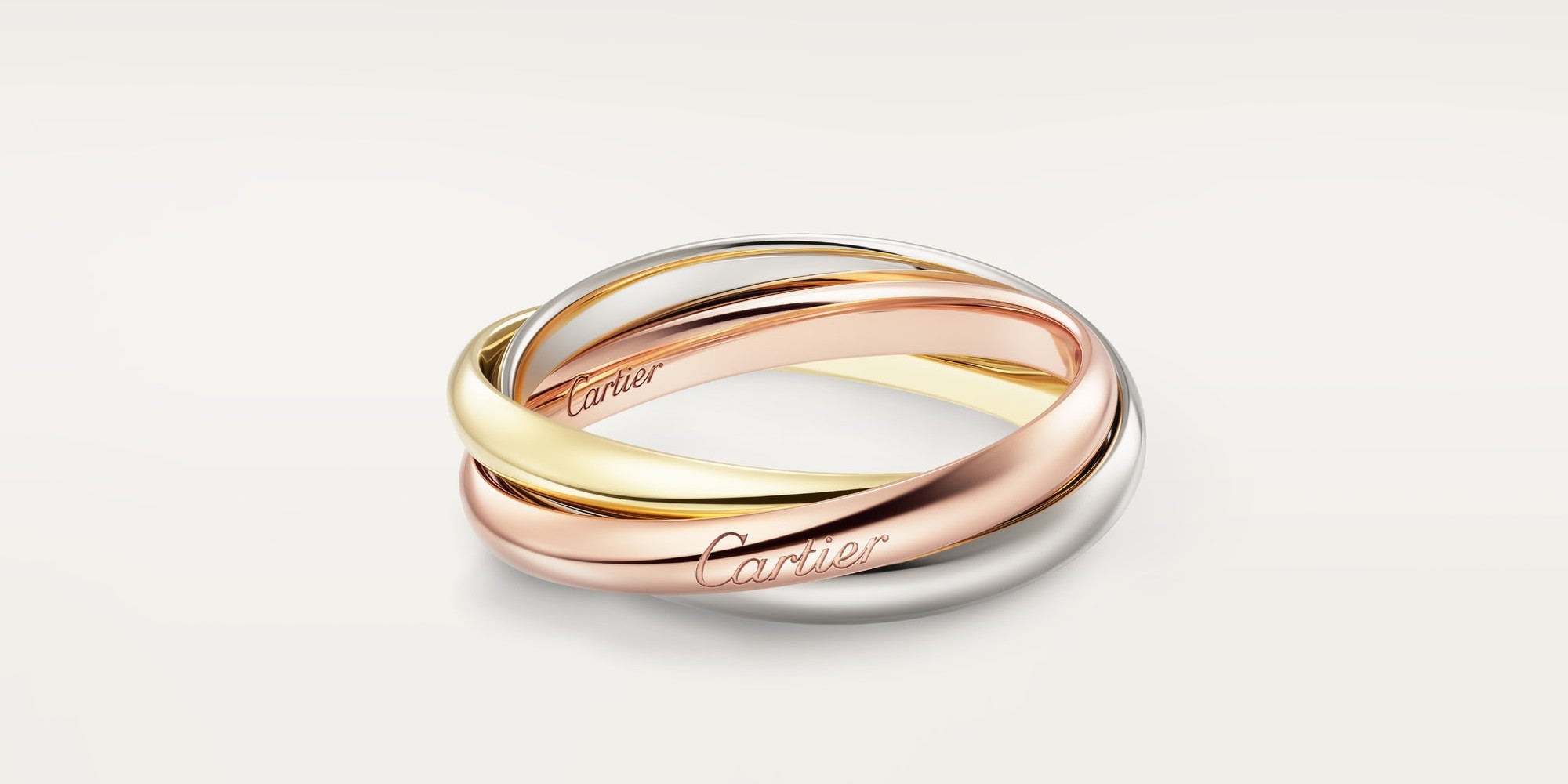
Trinity is the real entry point into Cartier. Louis Cartier designed it in 1924: three bands of rose, yellow, and white gold that are supposed to stand for love, fidelity, and friendship, though the bands do most of the talking and the symbolism is optional. The small ring, the on-chain version, and the mini-pendant are all around $1.8k in 2026. For someone who wants a Cartier that doesn’t read too “Cartier” from across a room, this is the one to start with.
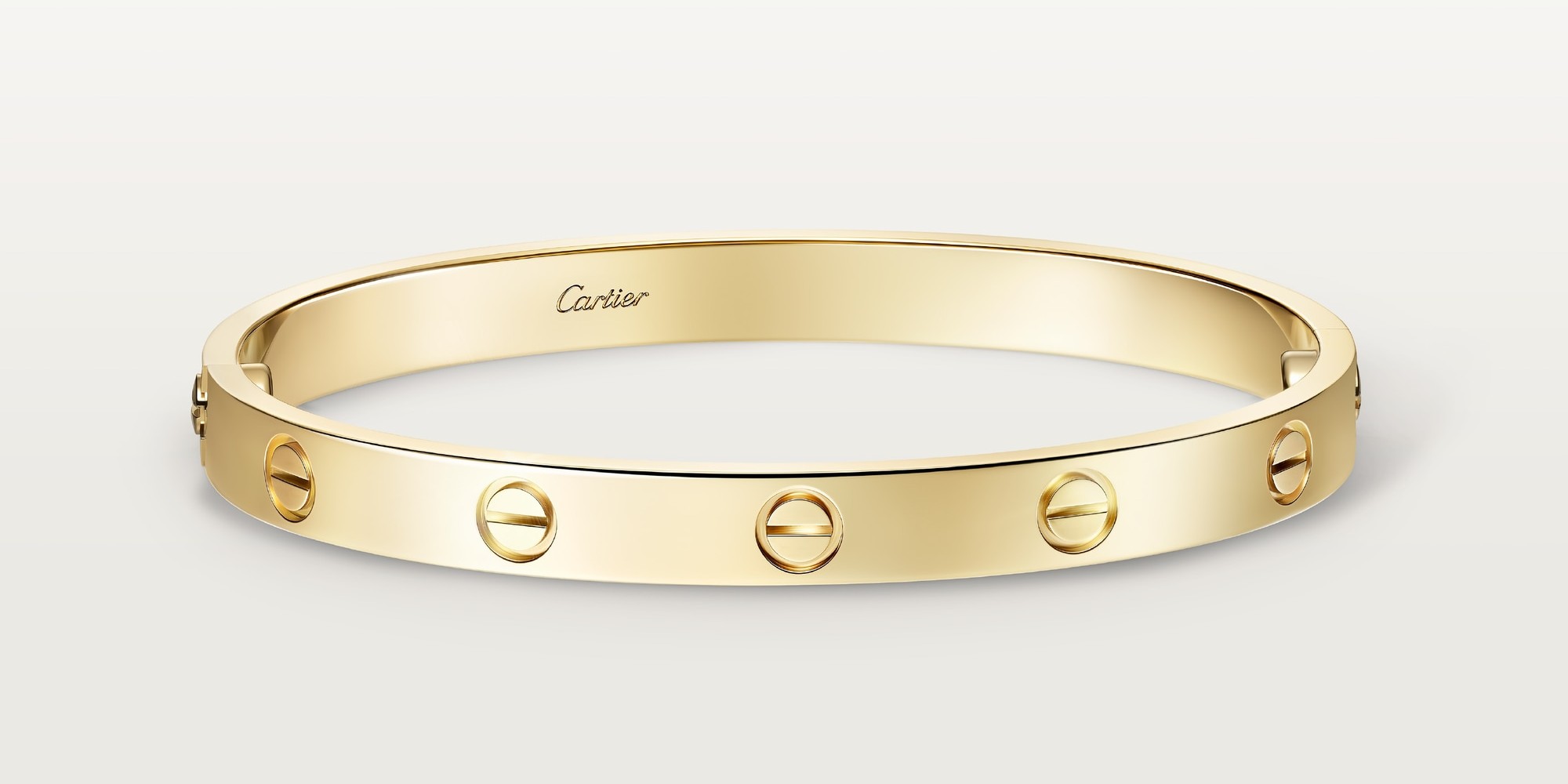
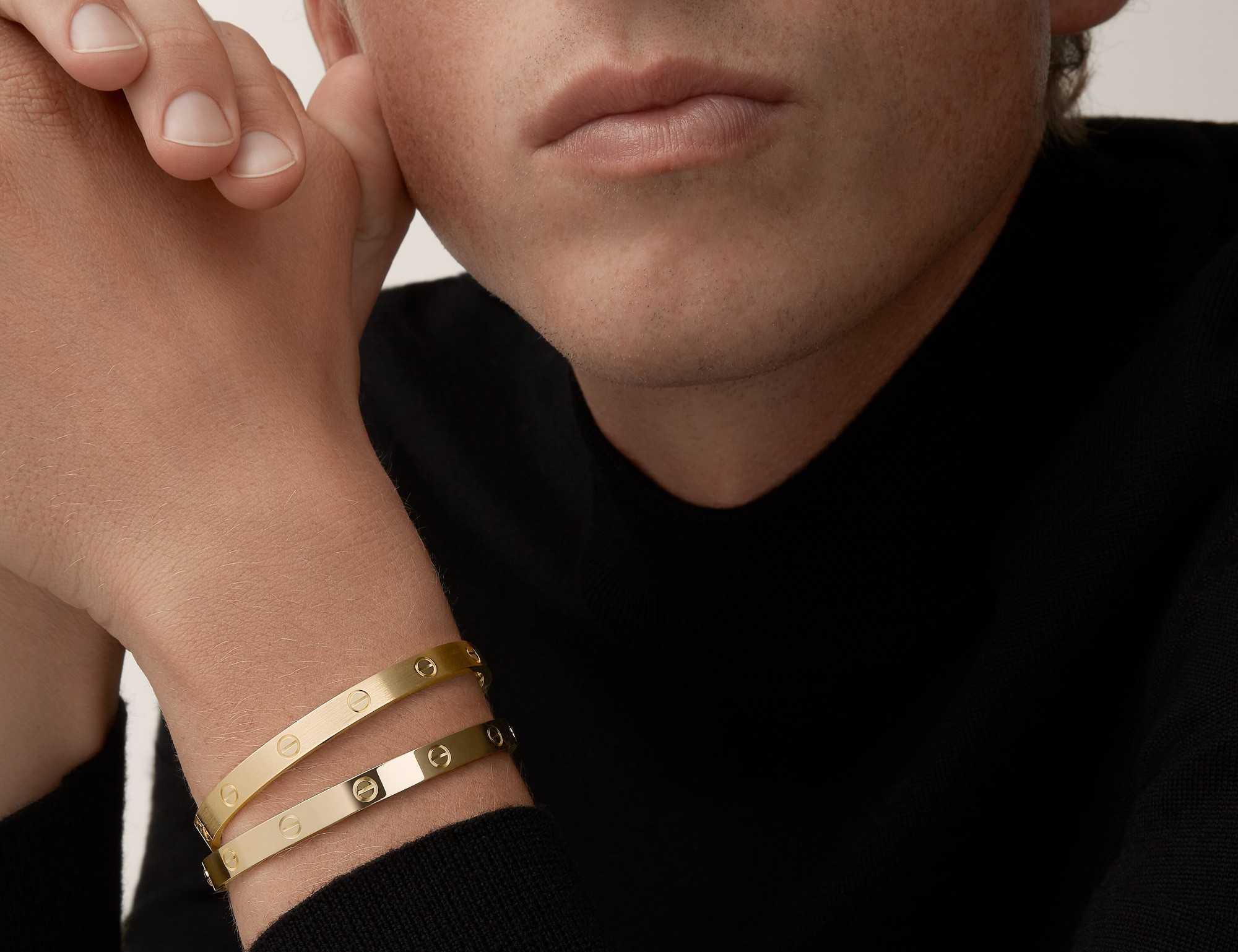
Cartier’s gravitational center is the bracelet with the screws. Cipullo’s 1969 design has been kept on the catalog with only the lightest hand for fifty-six years, and almost every other decision in the line takes its bearings from where the Love sits. The classic model in plain yellow gold currently lands at $8k. The piece is more photographed than any other fine jewelry design alive, and arguably than any jewelry design ever. It’s hard to argue given the Instagram archive of the last decade.
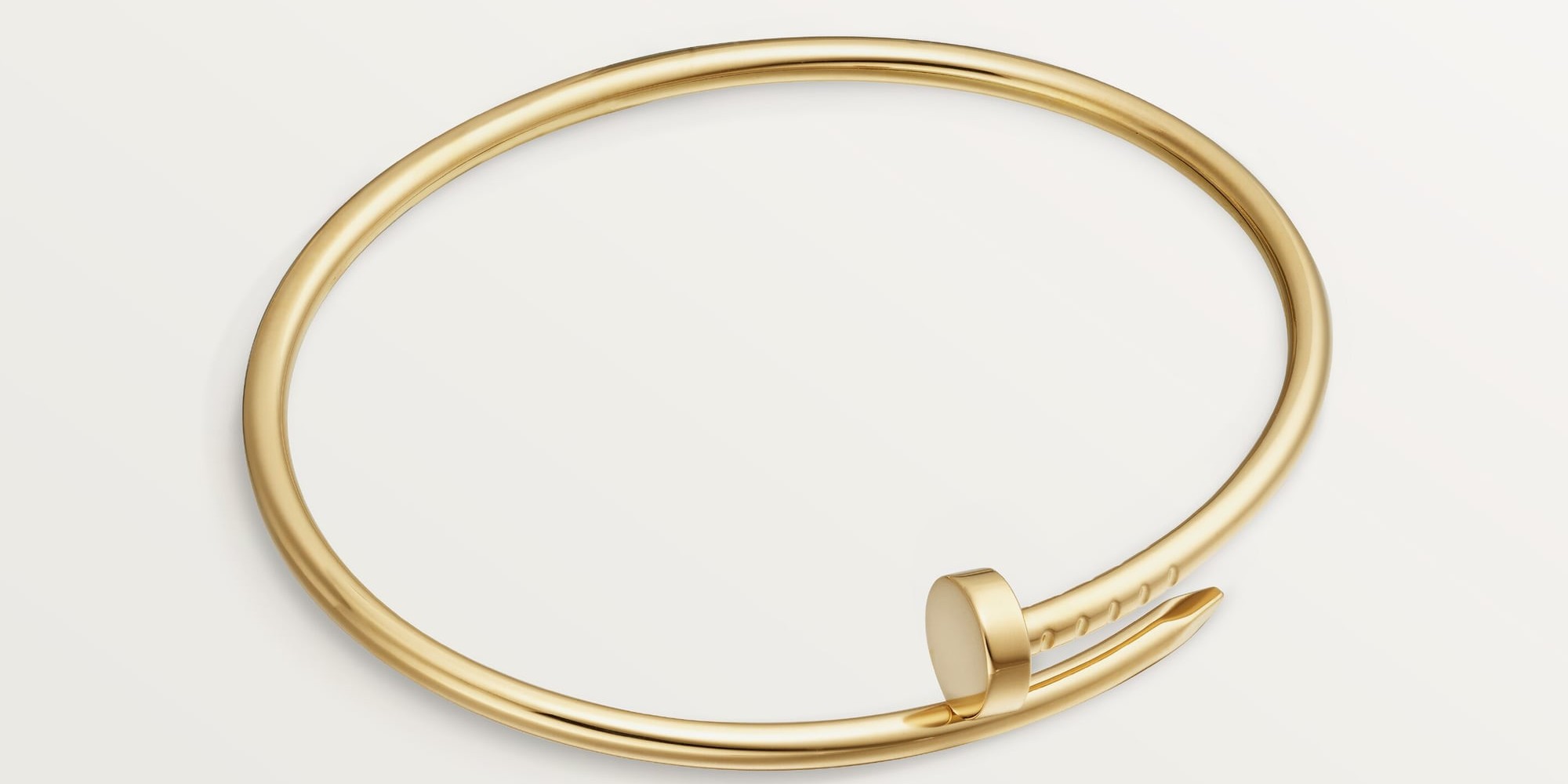
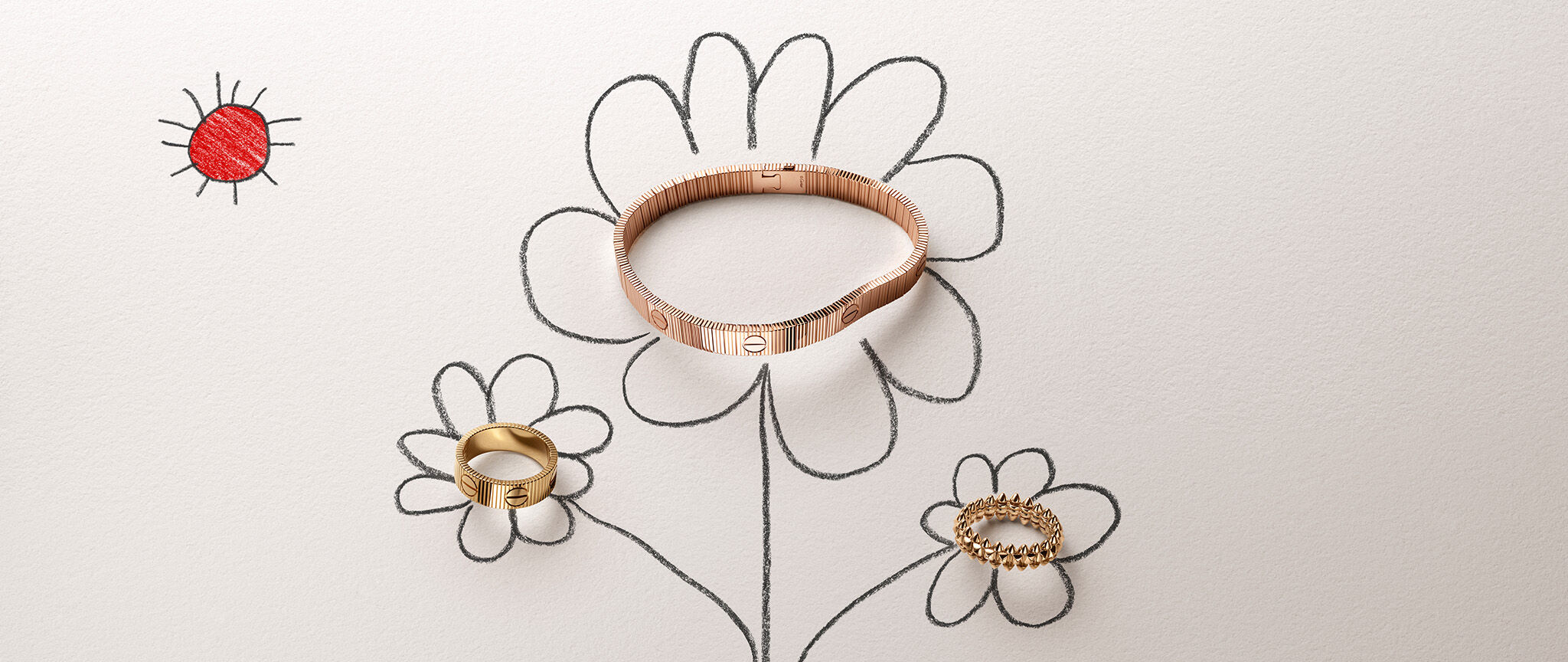
Juste un Clou is Cipullo again, 1971: a gold nail bent into a bracelet. It is the best icon-per-dollar buy in the catalog. The small model in plain yellow or rose gold is $4k, the ear “jewel” at $2.5k. JUC is where the house’s sense of humor lives, the piece that looks like hardware and reads like jewelry. It has also been pricing more aggressively than the Love, which matters to anyone weighing JUC on resale.
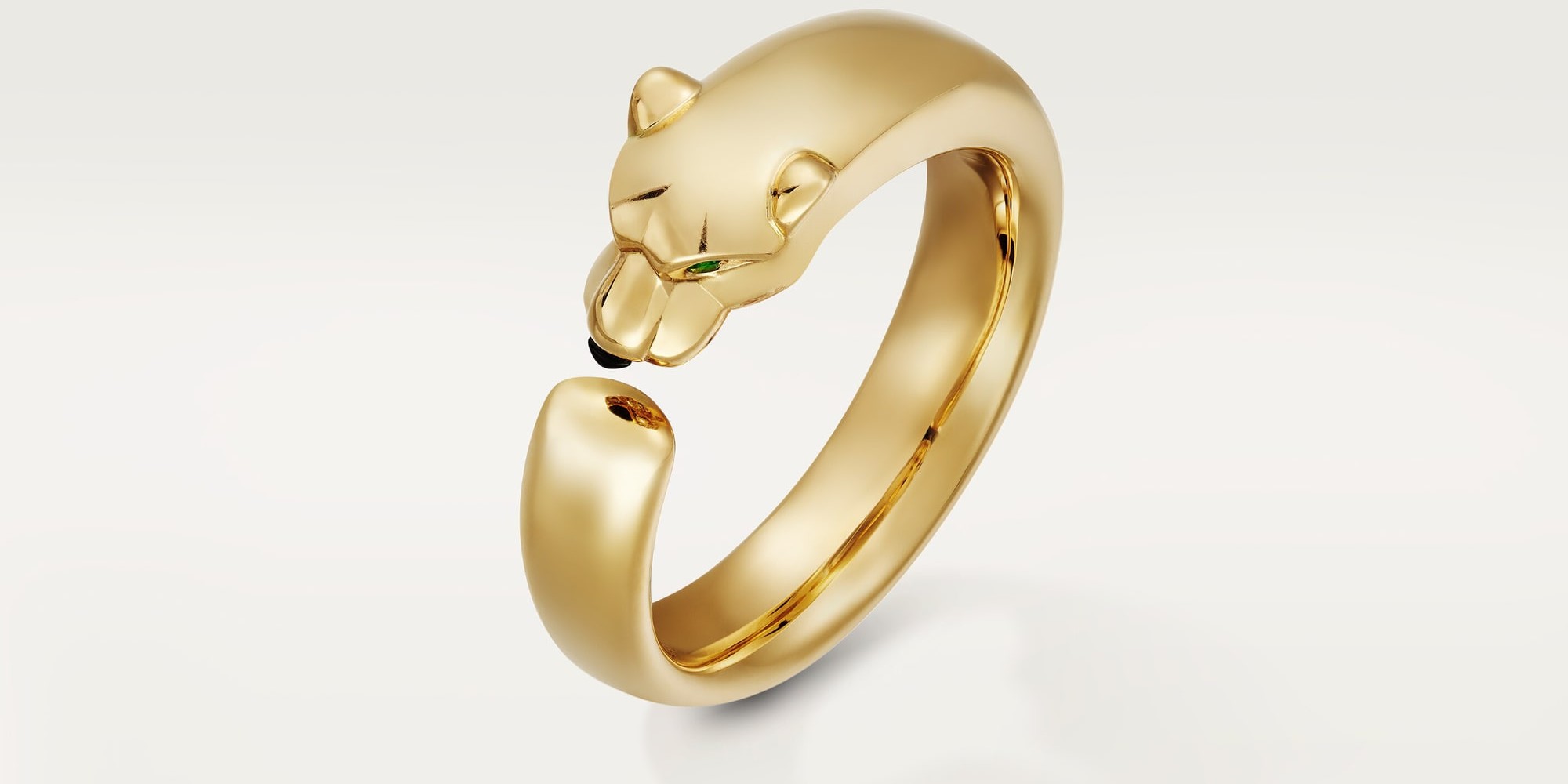
Panthère is the oldest motif in the house. The panther first appeared in Cartier work in the early 1910s and was elevated into a signature by Jeanne Toussaint over the decades that followed. The piece that did the elevating was the 1948 brooch she designed for Wallis Simpson with the Cartier designer Peter Lemarchand: a gold panther with black enamel spots, perched on a 116-carat cabochon emerald the Duke of Windsor had bought separately and delivered to Cartier for the setting. Simpson liked it enough to commission a second one a year later, and both pieces are the design ancestors of every Panthère in the current catalog. (The original sold at auction in 2010 for £4.5 million.) In 2025 Cartier put real weight behind the line with a major refresh. The small ring lands around $4,200. Panthère is the most flexible line in the catalog, running plain gold through pavé and lacquer, which means it is also the one that spreads widest in price.
Cartier on the wrist
The watch story is the same logic as the jewelry one applied to the wrist. Cartier invented the men’s wristwatch in 1904 when Louis designed the Santos for the aviator Alberto Santos-Dumont, who needed a watch on a strap because he could not dig a pocket watch out of his coat in a cockpit. Within a decade the wristwatch was standard for men under fifty.
The Tank came in 1917, after Louis saw a watch case in the parallel treads of a Renault FT-17 tank rolling across the Western Front. The first prototype was given to General John J. Pershing of the American Expeditionary Force. Serial production began in 1919; six watches went on sale that November and December, and every one of them had sold by January 17, 1920. The Tank is the most-copied dress watch silhouette in the world. Jackie Kennedy and Princess Diana both wore one.
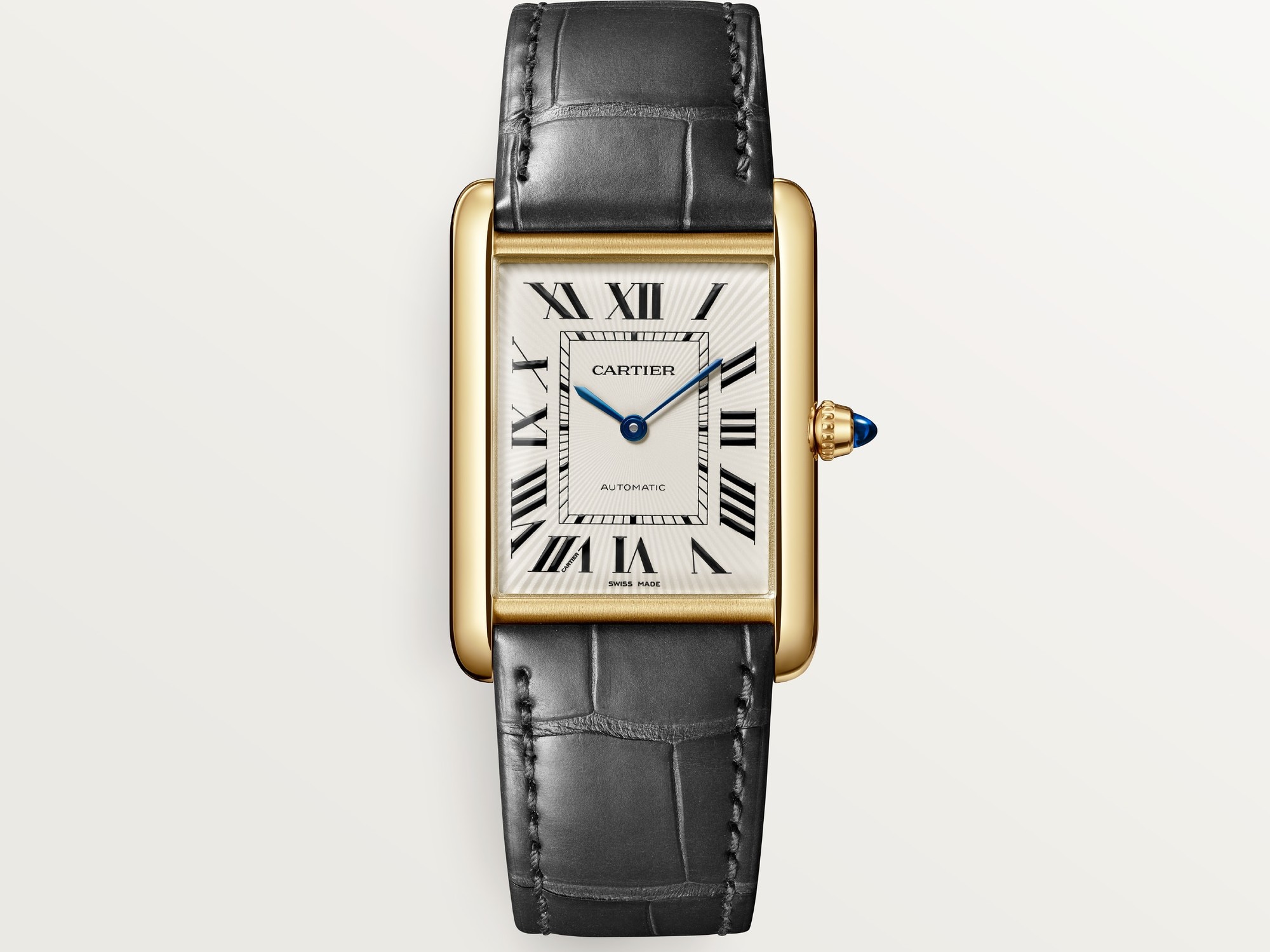
The other watches: Pasha (1985), Ballon Bleu (2007), Santos relaunched in 2018. Watches & Wonders 2025 brought new sizes and complications across both Tank and Santos.
Pricing in 2026: Tank Must in steel starts at about $4,000. The Tank Louis Cartier in 18k yellow gold with the new automatic movement runs around $14,900. Santos in steel starts at about $7,750. Diamond-set and gem-set models climb out of the primary register quickly. Verify current numbers on cartier.com before purchase.
The watch buying conversation is different from the jewelry one. Tank steel holds about 70 to 80% of new retail at three to five years on the secondary market, climbing higher for desirable vintage references. These are not investment pieces in the way vintage Pateks are. They are watches a buyer can wear daily for a decade and resell with most of the spend recovered.
If you’re shopping for an engagement ring
The bridal track at Cartier is a different buying conversation. The Solitaire 1895, designed in the year that gives it its name, is the brand’s anchor: a four-prong platinum solitaire built around a single diamond with the brand’s signature understated mounting. Entry-tier configurations in platinum start around $12,500 with a small center stone, and prices climb steeply with the diamond’s specs (carat, color, clarity, cut). A platinum Solitaire 1895 with a center diamond approaching two carats moves well into the five figures.
Other bridal lines: Etincelle de Cartier (a pavé-shoulder solitaire that brings the diamond down to a higher-set, more sparkly profile), Ballerine (a fifty-petal pavé halo around the center stone), Destinée (pavé-everywhere). Trinity Ruban makes a wedding-band pairing that picks up the three-band Trinity vocabulary in a band-only configuration.
The thing to know about Cartier bridal that the icon-jewelry conversation does not prepare a buyer for: the resale math is different. An engagement ring’s value at resale is mostly the diamond’s value, not the brand’s. A 1-carat Solitaire 1895 in platinum that sold for $20,000 retail will resell for the value of the 1-carat diamond plus a thin Cartier premium, not for 87% of $20,000 the way a Love bracelet would. Cartier holds its value better than most heritage houses across the catalog, but the Cartier-premium-as-percentage shows up most strongly on the icons, not on the diamond rings.
The buyer’s calculus on Cartier bridal: you are paying for the brand’s mounting work and the boutique experience, not for the rare-earth content of the stone. If you want the strongest resale-retention dollars, the diamond goes in a less branded mounting from a stone-first jeweler, and the Cartier money goes into a Love or a Trinity. If you want the engagement ring to feel like the pieces you grew up reading about, Cartier bridal is the answer.
The Cartier look and feel
Pick up a Love bracelet in plain yellow gold and the first thing you notice is the weight. It is heavier than a wrist expects from a piece this thin. The metal sits flat against the skin rather than riding above it, and plated brass a foot away picks up light in a way Cartier doesn’t. The difference is visible across a room, which is the design discipline doing its job. Pushing the same four motifs for fifty or a hundred years without cheapening them builds a vocabulary that reads at any distance.
Cartier sits in the category that marketing language keeps calling restraint. Trinity on a finger looks like three rings at first glance and Cartier at the second. Panthère with black lacquer eyes is the piece that will get noticed first; everything else in the catalog is a delayed recognition.

Where you meet the brand
The mother ships are 13 rue de la Paix in Paris, where Louis Cartier moved the house in 1899, and 175-177 New Bond Street in London, open since 1909. Both are genuinely old walls. The Fifth Avenue House in New York is the one most Americans picture when they hear “Cartier boutique,” and that building deserves its own piece rather than a paragraph here. What matters for a first Cartier purchase is that the regional boutique experience is competent, unrushed, and treats a $2,000 Trinity with the same care as a $40,000 bracelet. That kind of evenness is rare at this price, and it is part of what the premium buys.
Walk into Cartier’s 28 Newbury Street boutique in Boston and the first thing that registers is the silence. Four floors, just under 20,000 square feet across what is now one of the most expensive blocks in New England, and the floor staff outnumbers the buyers on most weekday afternoons. It is quieter than the Fifth Avenue House by an order of magnitude, more focused on the buyer than on the spectacle, and it suits a purchase at this price. For a buyer who doesn’t live in New York or Paris, the boutique you walk into is usually Boston, Chicago, Bal Harbour, or Beverly Hills, and 28 Newbury is the current benchmark for what a regional Cartier feels like. The way the same Trinity gets the same care here as on rue de la Paix is part of what keeps the icons from drifting region to region.
What you don’t realize until you’re in the boutique is that getting a Love bracelet onto a wrist for the first time is a small ritual involving two people, a screwdriver, and a fitting that takes longer than expected. The bracelet doesn’t just snap on. The salesperson holds the two halves to the wrist, threads the gold screws by hand, and tightens them with the small flathead. Coming back off later in the same store at the same counter is harder still. The Love gets stuck. Two people sometimes struggle with it. Watching that happen up close, with someone you came in with on the receiving end, is oddly intimate. Cipullo’s 1969 conceit still does what it was designed to do.
Pricing
Cartier prices its icons the way a house prices what it intends to keep iconic: in lumpy, infrequent steps that protect each piece from drifting into fashion. The pattern matters more than any single number. A Love bracelet in classic yellow gold was $6,350 in 2019, $6,550 in 2020, $6,900 by late 2021, and then sat flat for eighteen months before moving to $7,350 in April 2023, sat flat again, and jumped to $7,950 in September 2025. That is a 25% lift over seven years, delivered in four steps of roughly 4 to 8% each, with long plateaus between them. Juste un Clou has been more aggressive, climbing about 23% in three years through its own step pattern. A May 21, 2026 round is being whispered about on PurseForum and Reddit; nothing has been confirmed and Cartier never announces these in advance.
Entry into the brand is around $1,700, the Trinity small ring in plain gold. The sweet spot for a first meaningful Cartier piece runs roughly $3,000 to $5,000, which puts Etincelle solitaires ($3,350 to $3,600), Juste un Clou small ($4,180), Panthère small rings ($4,200), and Tank Must steel ($4,000) in range. The Love classic sits just above at $7,950, and men’s Santos models climb from $7,750 through $8,650 and out of the primary register entirely.
The durable read of Cartier pricing is that it rises in lumps against a gold floor that is itself still climbing, not in a smooth annual curve. A Cartier piece priced a year ago may well be the same number today, and may also be a few hundred dollars short of a bump nobody has announced. A current shopper is better served planning for the next increase than anchoring off the last one.
Resale
Resale is where the design discipline shows up as a number. The brand-average retention number that gets cited everywhere is Rebag’s 87%, from its 2025 Clair Report, and it holds up. It is a brand-wide basket average on a strong year. The spread on individual pieces runs wider than the headline number suggests.
Rebag’s 2025 data includes a Trinity On Cord at 112% of retail, which almost certainly reflects resale prices staying put while Cartier raised new-retail numbers underneath them. The Love classic on The RealReal has been moving at roughly $4,800 against an estimated $6,900 retail on one recent sold comp, closer to 71%. Fashionphile’s Cartier range runs from the low 70s into the mid 80s on recent sold comps depending on piece, condition, and moment.
The harder math is what happens after inflation. A buyer who bought a Love classic in early 2020 at $6,550 and sold it this spring at 87% of the $7,950 current retail walks away with about $6,917. That is a 5.6% nominal return over six years, during which the Consumer Price Index rose roughly 25%. In real money, the position is down around 15 to 18%. A buyer who bought in April 2022 and sold now at 87% is roughly flat nominally and down 12% in real terms. Juste un Clou bought in April 2023 and sold now at 87% lands at roughly 1% nominal and minus 7% real.
Cartier retains value better than almost anything else at this register, but a six-year hold still loses to inflation in real dollars. The useful frame is insurance against luxury-goods depreciation. The piece held most of its purchasing power in a period when most luxury goods held much less. The basic investment math doesn’t tell the whole story at all. Across tech, fashion, cars, you name it, the value doesn’t hold year over year. That gadget has maybe 10-20% resale value, that dress even less. Cartier is the adornment that holds over time. Where else can you rent charisma for a couple of bucks a month?
Buying used
The same design discipline is the reason secondhand Cartier makes more sense than secondhand most other things. A 2010 Love bracelet still says the same thing on a wrist that a 2026 Love bracelet does, because the piece has not changed and Cartier has spent the intervening years protecting its meaning. The buyer who pays 65 to 75% of new retail for a vintage Love is buying the same icon, with a different paper trail.
The constraint to plan around is the Enquirus database mentioned earlier. Cartier will not service in-boutique any piece it cannot trace to itself. For pieces sold after roughly 2010 this is a low bar; most have full Cartier paper, and the boutique will recognize the serial. For pre-2010 pieces, the database may not have an entry, and service has to route through independent jewelers who work with Cartier movements and parts. That is not a deal-breaker, but it is a real cost factor over the life of the piece, and it is the single biggest reason to buy from a seller with documented Cartier provenance.
The Love sets the spread you can actually verify in real time. A Love classic in yellow gold has been moving between roughly $4,800 on The RealReal in clean, papered condition and $6,250 on 1stDibs for an estate piece with a heritage-house provenance, against the $7,950 new-retail. The other icons track the same general retention pattern as the brand basket (high 70s to mid 80s of new retail), with Panthère sitting closer to retail because secondhand supply is thinner and Trinity priced closer to entry-tier because the rose-gold band typically shows wear first. Sample current listings on Fashionphile, Rebag, and The RealReal before buying; the spread on any specific piece moves with condition, papers, and the day.
Two rules. Always buy from a seller with documented Cartier provenance: the original receipt, the original box, and the certificate, ideally all three. Always factor independent service into the math if the piece predates the Enquirus era; if you are not willing to manage repair outside the boutique channel, buy from a platform that authenticates and routes service through its own pipeline (Fashionphile and The RealReal both do this for Cartier). The secondhand jewelry guide covers the platform-by-platform mechanics in more detail.
Service and repair
Cartier will not fully polish a piece more than three times in its life. The reasoning is structural. Aggressive polishing removes metal, blurs original edges, and eventually eats the hallmark. After the third polish, work becomes more conservative, and a heavily-worn piece will start showing wear the brand has decided to leave visible. That is the design discipline making a choice: preserve the original silhouette over restoring the piece to brand-new shine. It is the same logic that put a screwdriver in the original Love box and has kept it in the box for fifty-six years. Cartier preserves a piece’s history rather than papering over it.
The rest of the service infrastructure runs the same way, stricter than most buyers know and designed to keep the icons recognizable over decades. The international limited warranty runs two years from the date of purchase and covers manufacturing defects. Past that, service starts around $245 as a practical minimum, which covers small work like a resize within original tolerance or a simple clasp fix. Involved jobs (polishing, stone tightening, re-plating on white gold) run higher and take longer. Turnaround can be two weeks for boutique-level adjustments and up to four months for anything routed back to Paris, which is not unusual.
Caring for your Cartier
Service is what Cartier will do. Care is what you can do that protects the piece between visits.
The Love bracelet’s modern hinge mechanism wears with regular sleep, shower, and gym use. The bracelet was designed to live on a wrist permanently, which is the romance of the original 1969 conceit, but the contemporary hinge is a precision part with metal-on-metal contact that loosens if it is slept on for years and exposed to chlorine. Most owners take the Love off for serious workouts, beach time, and chlorinated water. The brand’s official guidance is similar.
Trinity is more rugged in concept (a three-band ring with no hinge), but the rose-gold band is the softest of the three metals and shows the first wear. Stack Trinity with rougher rings on the same hand and the rose gold takes the hit. A small thing to know if Trinity is on the dominant hand alongside other rings.
Pavé pieces (the diamond-set Panthère models, the Etincelle, anything with stones) need to come off for serious physical contact. The diamonds chip on hard surfaces, and lost stones are not warranty-covered. Pavé in a bag, on the gym, or against a steering wheel for years adds up.
Cleaning: warm water, a drop of dish soap, a soft toothbrush. Avoid ultrasonic cleaners on pavé and on anything with lacquer or onyx (Panthère with black eyes, anything with enamel) because the vibration loosens settings and can crack lacquer. Avoid jewelry-cleaning solutions sold by drugstore chains; many are stronger than 18-karat gold and rhodium-plated white gold should encounter. A Cartier boutique will do a free clean-and-check on most pieces; bring the piece in twice a year if you wear it daily.
Storage: separate pouches. Gold scratches gold. The Cartier service envelope or pouch is the right size for a Trinity or a Love; a Panthère ring with stones should be in its own box.
Insurance: appraise within thirty days of purchase. Most jeweler’s-block riders update the appraisal every three years; the Cartier price increases since 2019 mean an under-insured piece almost certainly is.
Cultural moments
Taylor Swift has been wearing the new Love Unlimited bracelet alongside the Santos Demoiselle she had on when she announced her engagement to Travis Kelce. Jacob Elordi is in the same Love Unlimited piece on press rounds. Timothée Chalamet has been on a Cartier run across 2025 and 2026, including the new Tank à Guichets courtside at the Knicks, a pink Ballon Bleu at the Berlinale, and a vintage Cartier as a bolo tie at the SAG Awards. The brand’s current relevance is certainly not in question.
The 2025 campaign year did the parallel work. Love Unlimited moved the bracelet off its 1969 romantic frame and opened it to any two people with a case for the screwdriver, which is a remarkable thing for a piece designed around a couple-only conceit to do at fifty-six years old. The bracelet is now visibly being given to siblings, best friends, and mothers on the brand’s own channels, and that changes the meaning of the bracelet on a stranger’s wrist in a way that matters. Panthère also received a significant update.
On cadence, Cartier shifted in 2025 from a single annual price increase to two, in May and September, which is the pattern feeding the May 21, 2026 rumor mentioned earlier. Parent company Richemont posted €15.3 billion in Jewellery Maisons revenue last fiscal year, and Cartier is the large share of it. The brand’s economic position has rarely been stronger, which matters because the ability to keep raising prices is not in question.
What’s wrong with Cartier
The polish rule is the romantic version of Cartier service. The on-the-ground version is messier. Online complaint volume on the brand has climbed steadily over the last few years, with consistent patterns: repair timelines that stretch to roughly twenty-eight weeks for involved work, recurring Love-bracelet hinge and screw failures, resize work that comes back the wrong dimension, and a customer-service apparatus that does not always respond to phone calls or email. Better Business Bureau and Trustpilot pages tell some of the story. Watch and PurseForum threads tell the rest. The brand’s response pattern, in cases where customers can document the defect, has typically been to charge for the repair anyway.
On sourcing, Cartier’s transparency lags its closest peer. Human Rights Watch’s most recent jewelry-industry assessment placed Cartier in the “moderate” tier, below Tiffany & Co.’s “strong.” The diamonds are Kimberley Process compliant and sourced through Responsible Jewelry Council-certified mines, which is the table-stakes level for heritage houses. The gold and colored-stone chains are less fully traced. For an ethics-conscious buyer at this tier, the gap is real, and Tiffany is the most straightforward heritage alternative on that axis.
Buyers at this register are betting on the design discipline, the resale market, the boutique experience, and the cultural durability of the icons. Those bets still pay. But the service apparatus, the brand-fight posture, and the sourcing transparency are weaker than the marketing implies, and a buyer should know all three before walking in.
Where it earns, where it doesn’t
The discipline is what Cartier is selling, and it works. Cartier is the most reliably value-retaining jewelry house at this register, and the resale market proves it. But the strength of the resale market is the evidence against the investment story, not for it. A buyer who paid $6,550 in 2020 and sells at 87% today walks away nominal-positive and real-negative. That is not a failure on Cartier’s part; it is the brand working as designed. Cartier holds its value against a luxury market where most goods lose theirs, and the price of that holding is roughly the rate of inflation.
Where Cartier earns its premium without argument: form, service, recognizability, and the confidence that the piece will still mean something in twenty years. Where it doesn’t: the claim, implied by a hundred SEO articles, that the piece stores real absolute value. In real dollars, it stores relative value. The piece moved at roughly the rate of inflation across a period when most luxury goods fell behind it, and that is the claim the math supports.
Among the current pieces, Juste un Clou has been pricing most aggressively and is the one most exposed to the next increase for a new buyer. The Love has been pricing more measured and currently looks least likely to jump again this year. Trinity had its strongest refresh in 2025 and is the clean entry point into the house for someone who has never owned a Cartier. Panthère is the strongest creative statement in the current lineup and the most flexible on price.
A buyer who buys a Cartier because their mother had one, or because they want one, or because it will carry a decade of work events with a single recognizable piece: those are the right reasons. A buyer who buys a Cartier because the internet told them it appreciates is buying into the marketing, not out of it.
If Cartier isn’t quite right for you
For a buyer who wants white-glove service from a heritage house with a different signature, Tiffany is the closest peer. I think of Cartier as sophisticated, I think of Tiffany as elegant. The design language is different, the resale retention is lower, and the service infrastructure is similarly strong. Van Cleef & Arpels Alhambra sits above and alongside Cartier for a buyer whose eye has gone French, and Bulgari Tubogas carries similar cultural weight with a Roman center of gravity.
American independents at the same register move the math further. Jade Trau at 485 Madison runs the Maverick Eternity band around $4,950, in a pavé discipline that reads completely differently on a hand. GOODSTONE out of Los Angeles carries a lifetime warranty on its work, which is structurally a stronger commitment than Cartier’s two years. Pomellato Nudo on the estate side carries weight with a different center of gravity again.
Next year the bracelet will almost certainly cost more. The screwdriver will be in the box. The question was never whether Cartier holds its value. It is what you want the piece to do, and whether Cartier is the house you want doing it.