Why Gold Jewelry Costs What It Does Right Now, and How to Buy It Smarter
At around $5,000 an ounce, gold is half the price tag on most fine jewelry. Here's how to read that price tag by gram weight and karat, why estate pieces are still priced at last cycle's gold market, and what 14k can do for you that 18k can't right now.
You’ve been watching the same chain for a month. When you first put it in a wishlist tab it was $2,800. You checked back last week and it’s $3,600, same chain, same brand, same description. You didn’t misremember. Gold spiked to an all-time high of $5,594.82 an ounce on January 29 per JCK, with Reuters clocking $5,181.84 intraday two days earlier, and it held above $5,000 for most of February. The retail price of anything that’s mostly gold went with it. Gold has pulled back since (Westmetall’s London Fixing put it at $4,771.85 on April 14, after a 10%-plus drop tied to the U.S.-Israel-Iran flare-up that started February 28), but the chain on your wishlist is still at the new number. That’s not a mistake. Brands re-tag fast on the way up and slow on the way down.
The reflex is to close the tab and wait for the price to drop. Don’t. The category you’re shopping in didn’t get more expensive in some uniform way. One variable inside it got expensive and stayed volatile, and the smart move now is to learn how much of what you’re paying for is that variable versus everything else. Because the answer is wildly different piece to piece, and it wasn’t worth caring about three years ago.
What $5,000 Gold Does to a Price Tag
A price tag on a gold chain is three things stacked: the metal, the labor and design, and the brand. The metal part used to be small enough that nobody noticed much when the price of gold moved. It isn’t anymore.
Run the math at the current spot. At $4,771 an ounce (Westmetall’s London Fixing for April 14), pure gold is $153.42 a gram. An 18k piece, which is 75% gold by weight, has about $115 a gram in raw material. A 14k piece, at 58.5% gold, has about $90 a gram. An 18-inch 18k rope chain at five grams contains $575 of metal at melt; at eight grams, $920. Add labor, finishing, margin, and retail markup, and an honest price for a real chain at real weight lands somewhere between $1,800 and $3,500. That’s before anyone’s brand markup makes an appearance.
In early 2023 spot was around $1,835 (January 3, 2023 London Fixing). The same five-gram 18k chain had about $220 of gold in it. The brand and design premium carried most of the price. Today the metal can do half the work of the number on the tag. Which means every time gold moves, the retail moves, and there’s not much a brand can do about it except eat margin or pass it along. Most are passing it along.
Jewelry didn’t get expensive. Gold did. Design work didn’t. A smart piece of goldsmithing from a small studio in Brooklyn costs roughly the same to execute today as it did in 2022 (other than labor inflation, which never seems to keep up does it? But I digress…). But that whole piece is now sitting on top of a more expensive base cost of the lump of metal.
Some brands have started telling you this directly. Kinn’s FAQ literally publishes the gold spot price as part of its pricing explainer (“As of January 28, 2026, the price of gold is $5,305 per ounce”) and warns buyers that prices may shift. That’s a brand admitting on its own site that the metal market is now part of the relationship. It’s a useful tell. The brands acknowledging volatility are usually the brands not playing games with weight.
Why Pieces Are Getting Lighter
The thing the industry isn’t advertising is that a lot of new jewelry is losing weight to hold its price. A chain that was 5 grams last year and $2,500 is now a 4-gram chain at $2,500. The silhouette looks the same. The heft in your hand gives it away. Call it shrinkflation in jewelry form.
Many companies are adopting this as explicit strategy, and saying so. JCK ran a piece in September 2025 quoting a designer saying outright, “We will focus on how to make items lighter weight and more affordable as prices rise.” Rapaport documented the same shift earlier in 2025, framing it as “daintier, less metal-heavy pieces” entering the assortment to keep entry-level price points reachable. That may be a tell that the fashion world pendulum may be swinging back to minimalism in the near future.
That is a reasonable response to a core material cost that’s tripled since early 2023, and it reads as one. But it does change how you shop. The number on the tag means slightly less than it used to. The number that matters more is grams and karat. Ask for it. If the brand won’t tell you, or the page doesn’t list it, factor that in.
The brands that publish gram weight up front (Kinn does on at least some PDPs, Sophie Ratner does, plenty of estate dealers do) are easier to trust right now because you can do the metal math yourself. Brands that don’t publish weight are asking you to pay on the basis of the name and the photograph. That’s always been a premium. It’s a bigger premium at $5,000 gold than it was at $2,000 gold.
14k Is Having a Moment It Didn’t Ask For
Something is shifting toward 14k that’s hard to ignore. One INSTORE retailer reported 14k sales up 422% versus the prior year, anecdotally, and the trade press has been talking about budget-per-gram for a year. The math is plain: at current spot, 18k holds about $25 more raw gold per gram than 14k. On a 30-gram piece that’s a $750 swing in metal exposure alone, before margin compounds it.
The “14k is harder than 18k” line you’ve heard from your jeweler is true on average but not universally. Stuller’s published Vickers hardness data shows it depends heavily on the alloy: 14K Yellow Standard runs HV 134, 14K Yellow Rich runs HV 162, 18K Yellow “For Rolling” sits at HV 141, 18K Yellow Euro at HV 115. So a hard 14k beats a soft 18k, an entry-level 14k loses to a rolling-grade 18k, and the right answer is to ask the brand which alloy they use.
What’s true is that the budget logic is now in 14k’s favor. If you’re buying a chain or a ring you plan to wear constantly, 14k at current gold prices is often the more honest purchase. It costs less, you can afford more weight, and the piece isn’t going to retire to a drawer because you’re scared of scratching it. The people who will tell you 18k is the only real gold are usually selling you 18k.
The Estate Market Is Where the Actual Deal Is
A lot of estate inventory is sitting on dealer shelves at prices set when gold was a third of where it is now. Rapaport ran a piece in March 2026 on the surge in vintage chain demand, quoting a dealer at For Future Reference Vintage saying flat out: making these pieces today would be tremendously costly given current gold and labor. The market has noticed. Dealers haven’t all re-priced.
JCK reported the same dynamic, in identical language, in 2011: “rapidly rising spot gold price isn’t fully reflected in the secondhand market,” and they called estate “a value proposition” then for exactly the reason it’s a value proposition now. The lag is structural. Estate inventory turns slowly, dealers anchor to acquisition cost, and the people writing checks for vintage pieces are usually shopping for the design and rarely running spot-price math at the counter.
You can do that math, though. Reputable estate dealers publish gram weight directly on listings: Lang Antiques, Erstwhile, Erie Basin all do. A vintage 14k piece listed at 8 grams and $1,400 has $720 of metal in it at current spot. The other $680 is buying you actual mid-century craftsmanship and a piece nobody else has. New equivalent at the same weight is going to run you $2,500 minimum once design and margin land on top. A vintage chain is the same chain today that it was in 1978. The gold content is exactly what it was. The craftsmanship from a mid-century Italian atelier is, in a lot of cases, better than what’s coming out of new factories.
This won’t last. Dealers are paying attention and Rapaport’s coverage is accelerating the awareness. The window where vintage is priced at last cycle’s gold market is closing. But for the moment, estate is doing something new jewelry structurally can’t: sitting at prices set before the metal moved.
A few rules for shopping it. (The full navigation guide for secondhand fine jewelry is here if you want the longer version.) You need a real dealer. Skip Etsy. A signed piece from a known maker (Bulgari, Pomellato, Buccellati, or good Italian chainmakers like UnoAErre) at gold-weight pricing is the buy. Unsigned mystery work isn’t. Read the return policy: Doyle & Doyle, for example, allows returns on items under $2,500 within seven days, but items $2,500 and over can only be exchanged or issued merchandise credit within 14 days, with multiple exclusions. That’s representative of the tier. The market assumes you’ve done your homework before you commit.
Tariffs Are Real, But Smaller Than the Gold Move
You’ve heard the tariff story. It’s true. It’s also smaller than people think relative to what gold itself did to your bill.
The actual numbers from the U.S. Harmonized Tariff Schedule are mostly single-digit ad valorem on finished gold jewelry: 5.5% on rings, 7% on gold neck chains, similar rates across the 7113.19 family. The bigger move is the post-2025 executive-order action that added 20% on goods from China and Hong Kong (CBP made it official in March 2025), which stacks on the base rate. The “13% to 31% across all countries” framing you may have seen is overstated for most jewelry sourced from Europe; it’s closer to true for the China-stacked subset.
The practical effect is that an Italian or French heritage piece is paying a small base tariff. A China-sourced piece is paying a much bigger one. Both are paying for the metal, and the metal is the much larger line item. A US-made independent skips the tariff entirely. That doesn’t make the European houses bad value. It does mean the gap between Cartier and a comparable American studio at similar weight has widened by enough to be worth thinking about.
The brands at this tier worth looking at for solid-gold basics include Sophie Ratner in New York (hand-fabricated in NYC, gram weight published on PDPs), WWAKE in Brooklyn (made-to-order in their Greenpoint studio), Marla Aaron (Diamond District, $100 to $300,000 spread, signature carabiner), Jennifer Meyer in Los Angeles, Grace Lee, and Catbird in Brooklyn. Kinn is worth knowing too with one caveat: they make in Los Angeles and New York, but their FAQ says “many of our chains are made in Italy,” so a Kinn chain may carry the same tariff math as the European houses depending on the piece. Ask. None of these brands will save you 50% over Cartier because they buy the same gold on the same market. They aren’t pancaking a tariff and a heritage premium on top of it.
Buying Into a Volatile Gold Market Without Flinching
Timing the gold market is a losing game. Central banks added 1,045 tonnes of gold in 2024 and 863 tonnes in 2025 per World Gold Council data, the highest sustained accumulation in modern history. The WGC’s 2026 Outlook notes that 2025 logged over 50 all-time highs and returns above 60%, with central banks and investors still allocating in. Geopolitics keeps spiking demand and then giving some back. Goldman Sachs raised its end-2026 forecast to $5,400 in January. BMI’s annual average forecast for 2026 was $4,600. Both could be right. Both could be wrong. Vogue ran a “state of jewelry in 2026” piece in February that named gold prices and tariffs in the same breath as the two forces shaping what people are buying. The structural story is volatility. Nobody should plan around a spike that politely returns to the mean.
Your gold, once bought, is bought at the price it was bought. If you buy the chain at $3,500 and gold climbs back to $5,500, the chain is worth more on metal alone. If gold drops to $4,000, the piece doesn’t evaporate. You have solid material on your neck that you chose because you liked it. You can verify it: Dillon Gage, one of the major refiners, publishes its terms openly at 80% of bid spot for lots under 10 pounds and 90% for lots over. That’s a real floor under the metal in your closet, and it moves with a real market.
Cost per wear is the only math that holds up across this volatility. A chain you wear four times a week for ten years costs about $1.70 a wear at $3,500. Gold at $6,000 doesn’t change your usage pattern. The piece is still on you. That math holds whether the commodity market does anything interesting or not.
If you want a specific game plan for right now: buy by weight when you can verify it, favor 14k for daily pieces, check the estate market before you check the new one, and give US-made independent designers a closer look than you would have three years ago. Ask any brand for the gram weight in writing before you buy. Skip gold-plated and vermeil for anything you want to keep (there’s a separate piece on that). And if you’ve been sitting on a piece in a wishlist for six months, do the gold-content math on it. The answer might be that it’s priced correctly and you should stop waiting. The other answer might be that it’s got thirty percent of its price tag in the metal and seventy percent in the brand, and the question is whether that ratio is worth it to you.
Or you’re not here for the math at all. You just want to know that gold jewelry holds its value better than almost anything else you’d spend this kind of money on, and that buying from someone who knows their weight-per-gram is a smarter move than buying the name on the box. Both true. Go buy the chain.
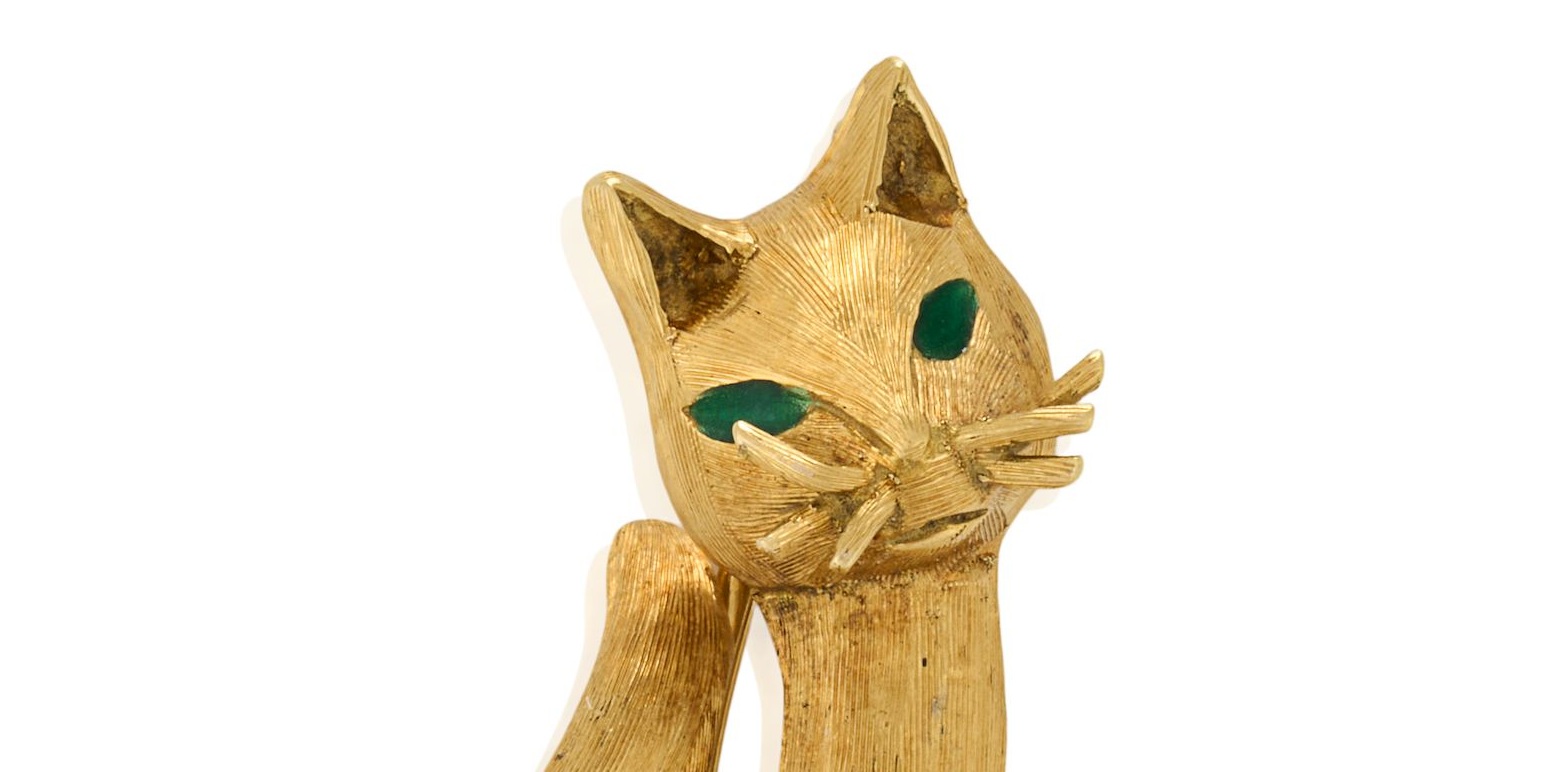
Sandy Lerner Is Rehoming Her Cats: A Tiffany Cat Brooch and Sixty-Five More
The Cisco co-founder spent four decades collecting cats in gold, enamel, amethyst and bronze. On 30 September 2026 Bonhams sells 66 of them in New York, from a $700 carved cat to a $120,000 bronze by the sculptor Rembrandt Bugatti. She is keeping the live ones.
Why Are Jewelry Prices Still Going Up?
Jewelry costs about 15% more than it did a year ago, and it is the gold accounting for most of it. The answer coming back from the jewelry trade and brands is less gold in the piece, which changes what you have to ask for at the counter.

Natural Diamond Prices Are Going Up Again, at Least for Now
Lab-grown stones pushed mined diamond prices down for years. The diamond trade's price index rose again in August, led by small stones. What that changes for you.
The newsletter.
One email when something is worth your attention. New essays, the buying calls behind them, and what we’re watching in the trade. No roundups, no affiliate dumps.