The Sapphire That Isn't Blue
The case for colored sapphires at the fine jewelry tier: teal, lavender, peach, yellow, and parti, and why non-blue sapphires are the smarter-money picks over blue right now.
Say “sapphire” and most people picture the same stone: royal blue, Princess Diana’s ring, the September birthstone sold at every chain jeweler in the country. Blue sapphires are beautiful. They are also where the conversation starts, and it runs much further.
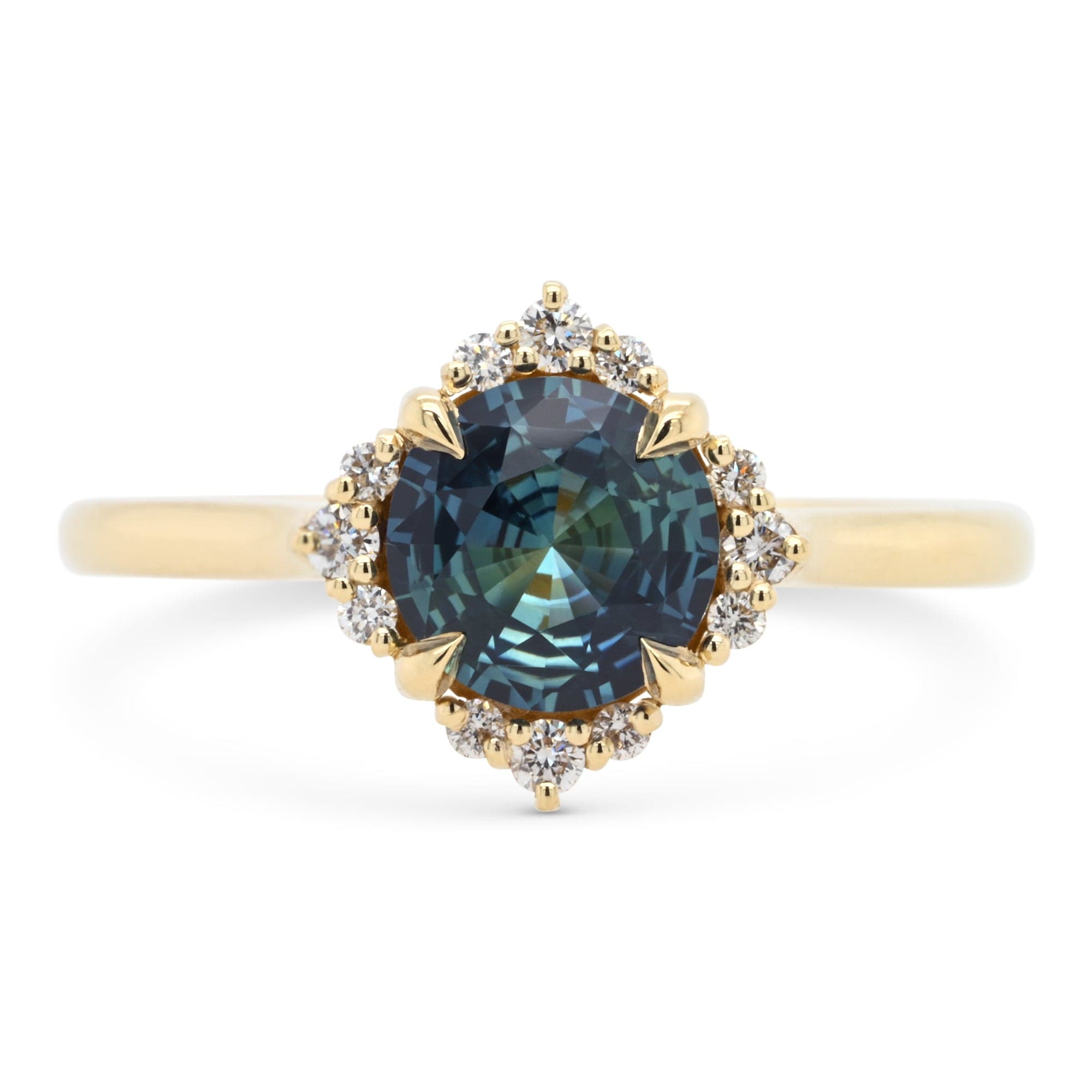
Colored sapphires (the non-blue ones) come in teal, lavender, peach, yellow, green, pink, and about a dozen shades that don’t have clean names because they shift between categories depending on the light. A teal sapphire that reads blue-green under fluorescent light turns more green in sunlight. A peach sapphire looks like a sunset got compressed into a stone. And at the fine jewelry tier, they’re worth buying for reasons the internet still hasn’t caught up to: teal already had its moment and is no longer the cheaper alternative to blue, and the smarter-money picks now are lavender, peach, yellow, and parti.
Nothing about these is second-tier. Same mineral (corundum), different trace elements, different colors. Graded the same way, set the same way, and priced on their own curves, which have moved faster than the buyer-side editorial coverage has. And the sapphire category’s real advantage has shifted, too. The reason to buy a colored sapphire over any other colored stone is that corundum gives you near-top-tier daily-wear durability across a wider color spectrum than almost any other fine jewelry stone.
A lavender sapphire that photographs purple can look almost grey in person, in a way that’s more interesting than either color on its own. That’s the kind of thing this stone does.
Why Now
Colored gemstones are the jewelry story of 2026, but not for the reasons most trend pieces say. The defensible version of what’s happening: lab-grown diamond prices have kept falling as volume scales, gold prices have kept climbing, and shoppers who want something that still feels rare and specific are looking sideways into colored stones and warm-toned diamonds. U.S. gemstone market research shows demand growing because consumers are moving past diamond-only jewelry toward stones with unique colors, stories, and rarity. That’s broader-market, not sapphire-specific, but it’s the real tailwind.
Inside that shift, Rapaport’s March 2026 read on the year is individuality, self-expression, and “stones with natural visual texture.” That last phrase is the one that matters. Color as a way to look like yourself instead of looking like the person next to you.
The editorial gap is still real: if you search for a teal or lavender sapphire ring buying advice, you’ll find gemological reference sites, a few retailer product pages, and almost nothing that helps a buyer with taste make a decision. Blue sapphires have decades of editorial attention. The rest of the spectrum has maybe two years, and the trade press is still catching up to what’s happening at independent designer prices.
The Durability Case
Before the colors, the thing you have to understand about sapphire is why it can be the only colored stone you own and wear every day.
Corundum is 9 on the Mohs scale. Per GIA, it has “excellent toughness and no cleavage,” and that combination “makes it a great choice for rings and other mountings subject to daily wear.” Translated out of gemology-speak: it resists scratches, it resists chipping, and there’s no internal grain along which it wants to split when it gets knocked.
Put that next to what most other colored stones want from you.
Emeralds. GIA says “some estimates state that 90 percent or more of emeralds are fracture-filled.” That filling is what lets them look clean enough to sell. It’s also why GIA’s care guidance warns against ultrasonic and steam cleaning on emeralds: vibration can weaken fractured stones and hot steam can cause oil or unhardened resin to sweat out of the stone. An emerald ring is a piece that needs rules. A sapphire ring is a piece you can forget you’re wearing.
Tanzanite is worse for daily wear. GIA describes its toughness as “fair to poor” and flags cleavage as “a tendency to break when struck.” The lab’s own guidance suggests keeping tanzanite to earrings or necklaces (because rings and bracelets get hit) and reserving those pieces for special occasions.
Tourmaline is the honest counter-example. GIA says it’s 7 to 7.5 on Mohs with fair toughness and is “durable enough for daily wear,” though heat and thermal shock can damage it. So other colored stones can qualify for daily wear. Sapphire just has the largest safety margin and the fewest caveats. If you want one colored stone you can wear constantly and casually without a cleaning ritual, sapphire is the standout answer.
That durability advantage holds across every color in the category, not just blue. Which is where the colors start to matter.
The Colors
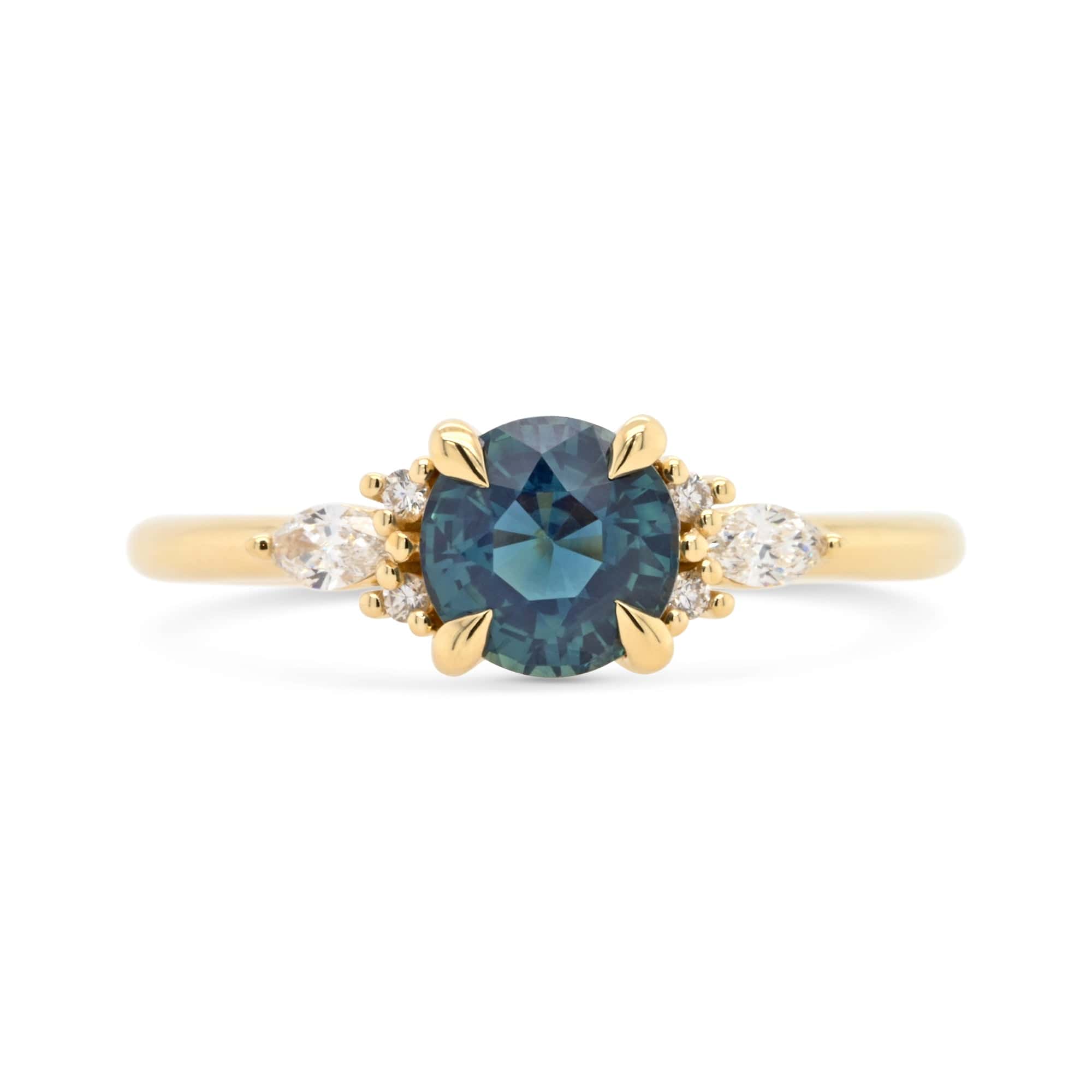
Teal. A mix of blue and green that shifts depending on lighting. Teal sapphires from Rock Creek, Montana are the ones most independent designers build around, because the color is strong and the Rock Creek sourcing story is unusually specific. Teal reads as modern, slightly unexpected, and pairs well with both yellow and white gold. It’s the color for someone who wants a colored stone that doesn’t read as “colored stone.” It just reads as beautiful and slightly off from what you expected.
Two years ago that was the pitch. It doesn’t work anymore. Teal is no longer the bargain alternative to blue. At independent designer retail, it’s often the premium. On Valerie Madison, a 1.11 ct teal sapphire engagement ring sits at $5,600 while a 1.03 ct cerulean blue sapphire engagement ring in the same setting family is $4,860. That’s roughly a 15% premium for teal at nearly identical sizes. Fine & Flux describes teal as having had a “significant surge in popularity, driving prices sharply upward.” Two or three years ago teal was the smart-money play. Today it’s a full-price color, and the shoppers who came to it late are paying for the brands that put it on the map.
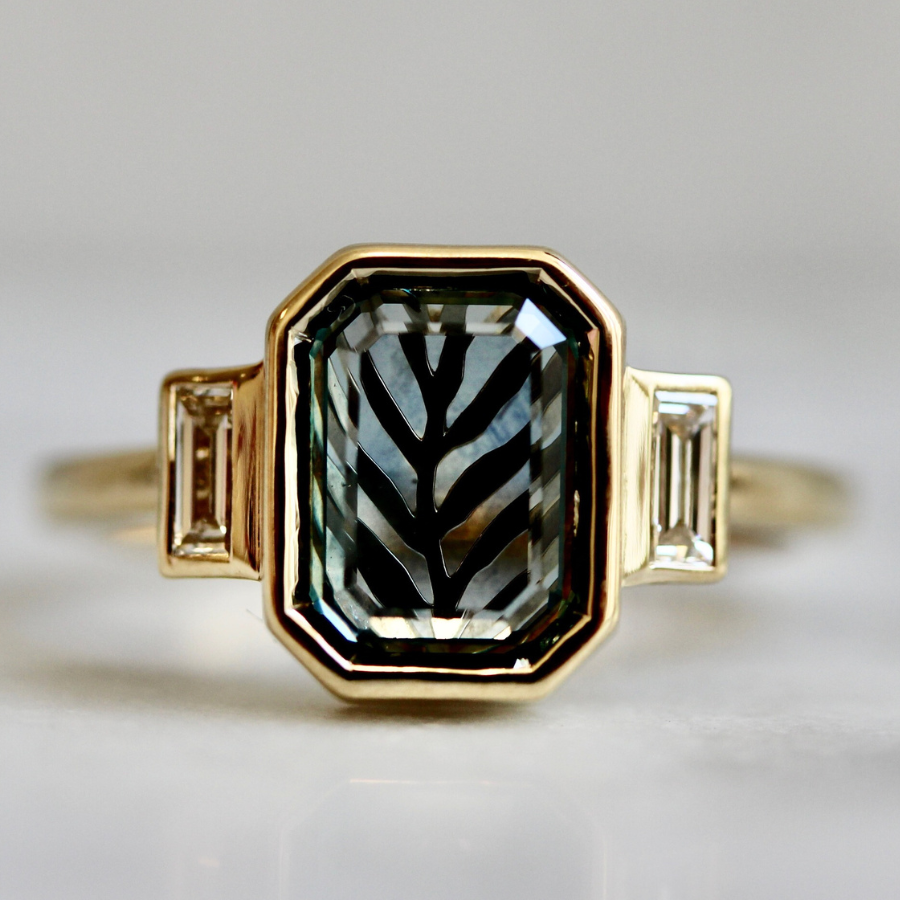
If you want teal anyway (because you just want teal), the cleanest in-window option is Bario Neal’s Allium Octad, a blue-green sapphire ring at $1,720 to $2,240. The brand uses “blue green” rather than “teal” as their catalog term, but that’s the color. Gem Breakfast’s Tree Star, a teal portrait-cut Montana sapphire ring, is $4,100 and is probably the cleanest “Montana + teal + current + mid-four-figures” example in the market right now.
Lavender. Softer, subtler, and harder to pin down. Lavender sapphires sit in a space between purple and grey that’s difficult to photograph and magnetic in person. They tend to be lighter in saturation than other colored sapphires, which makes them excellent for people who want color without commitment. In a gold setting, the warmth of the metal and the coolness of the stone create a tension that pulls you in. In white gold or platinum, they go cooler and more ethereal.
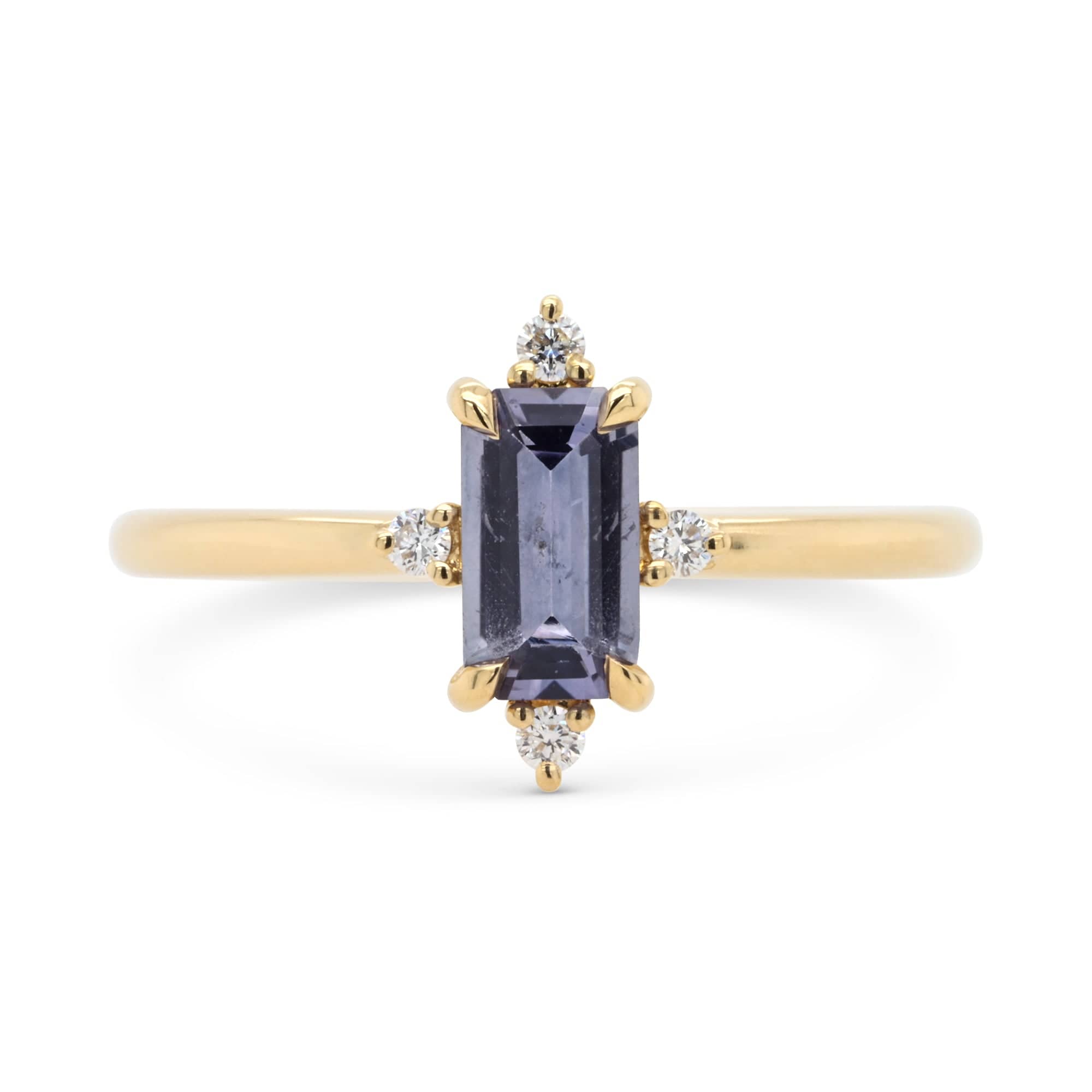
Lavender has its own quirk in the market: jewelers report that heat treatment, which is standard across the category, can push lavender toward blue or pink, so more lavender stones are marketed as untreated than in most other colors. That’s retail-trade commentary rather than settled lab doctrine, but it’s consistent enough across sources to know about. If you’re seeing untreated paperwork on a lavender stone, that’s part of why.
Live lavender rings in the $1,000 to $2,500 range are the thinnest current inventory in the whole category. The closest live examples sit just inside or above: a 0.40 ct light purple sapphire ring at Valerie Madison was $1,650 but is currently sold out, and Gem Breakfast’s Bowtiful purple-pear sapphire bow ring is $2,750, just above. Page Sargisson’s 18k freeform drop earring in lilac purple sapphire is a cleaner live buy at $2,030. If you want a lavender ring specifically, plan on a custom order.
Peach. The warmest of the non-blue sapphires, ranging from pale salmon to deep apricot. Peach sapphires have been having their own moment, partly driven by the padparadscha sapphire (the rarer pink-orange cousin that can command much higher prices). A peach sapphire in the $2,000 to $5,000 range won’t be a padparadscha, but it lives in the same visual territory.
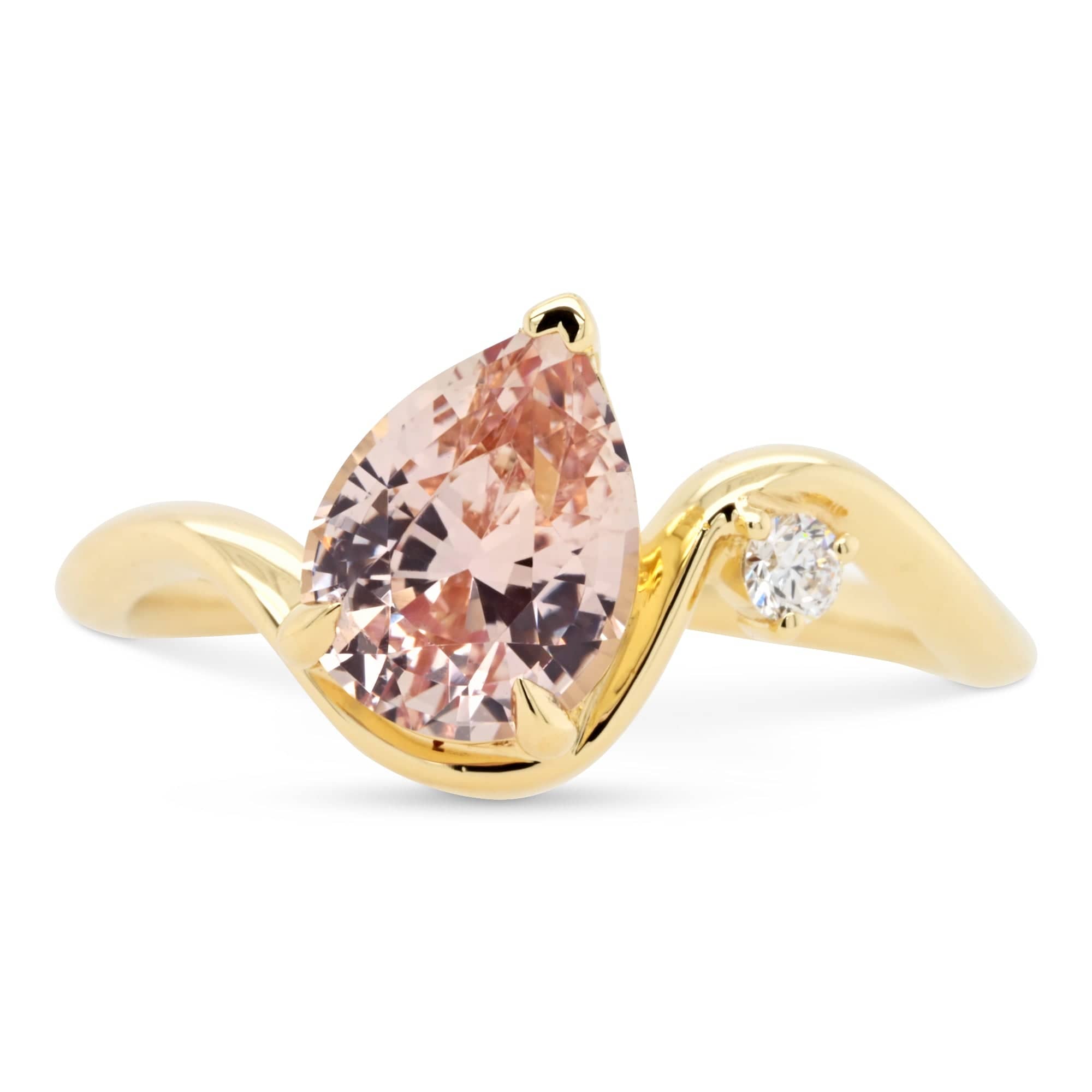
One note on the padparadscha comparison, because the internet is loose about it: the ratio between peach and padparadscha pricing isn’t clean, and current jeweler sources like Fine & Flux suggest padparadscha pricing overlaps with royal blue, which cuts against the much-higher numbers repeated in older guides. The honest version is that peach sits below padparadscha pricing without a clean multiplier. The live evidence at independent designer retail tells the more useful story: Valerie Madison’s Venus pear, a 1.72 ct peach sapphire engagement ring, is $5,400.
Yellow. The most underrated color in the category. Yellow sapphires stay more affordable than most colors because demand has lagged, and the current live pricing reflects it. Gem Breakfast’s Limoncello oval yellow sapphire ring is $2,950. Page Sargisson’s 18k freeform yellow sapphire charm pendant is $1,250, which is a serious piece of fine jewelry at a price that reads like a placeholder. If your taste is warmer and your budget is tighter, yellow is the color that rewards paying attention.
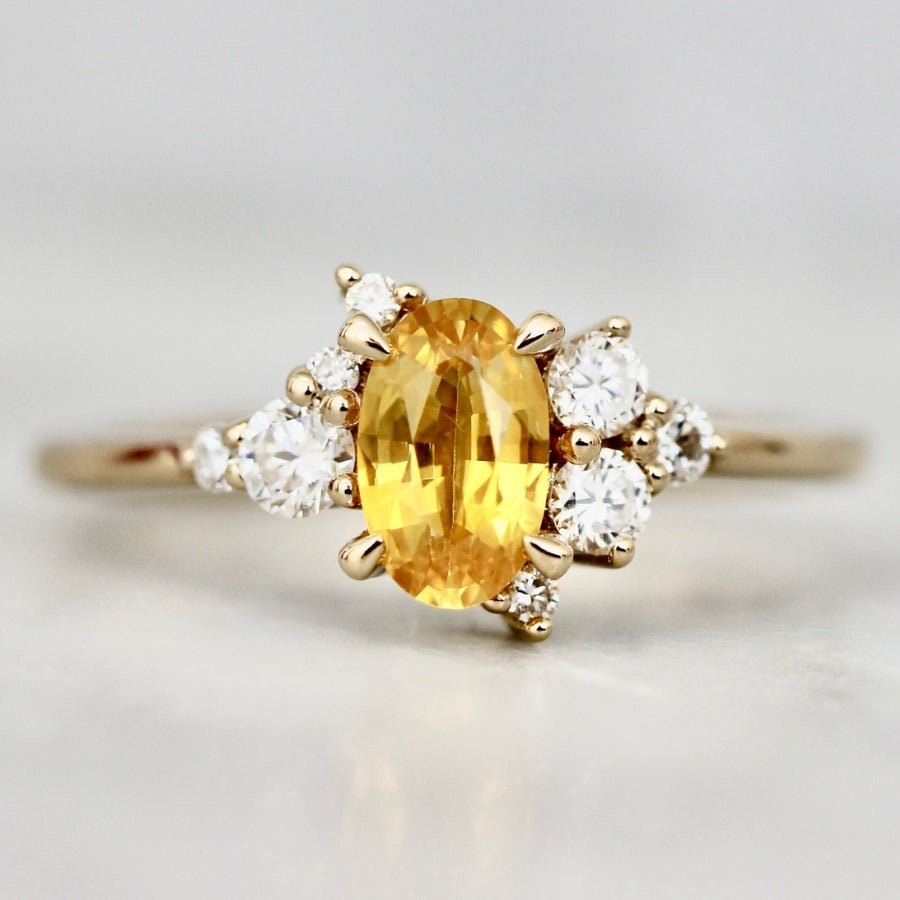
Parti. Bi-color and tri-color sapphires, where the stone cleanly shows two or three zones of color from a single crystal. These were trade curiosities five years ago. They’re now showing up in the exact part of the trend cycle that teal occupied in 2022. Gem Breakfast’s Golden Lime tri-color emerald cut sapphire ring is $4,650; Bario Neal’s custom bi-color sapphire cluster pendant runs $3,620 to $4,620. Parti is where someone with taste is looking now, which is exactly why you’d want one before the Valerie Madison 2028 guide names it the color of the year.
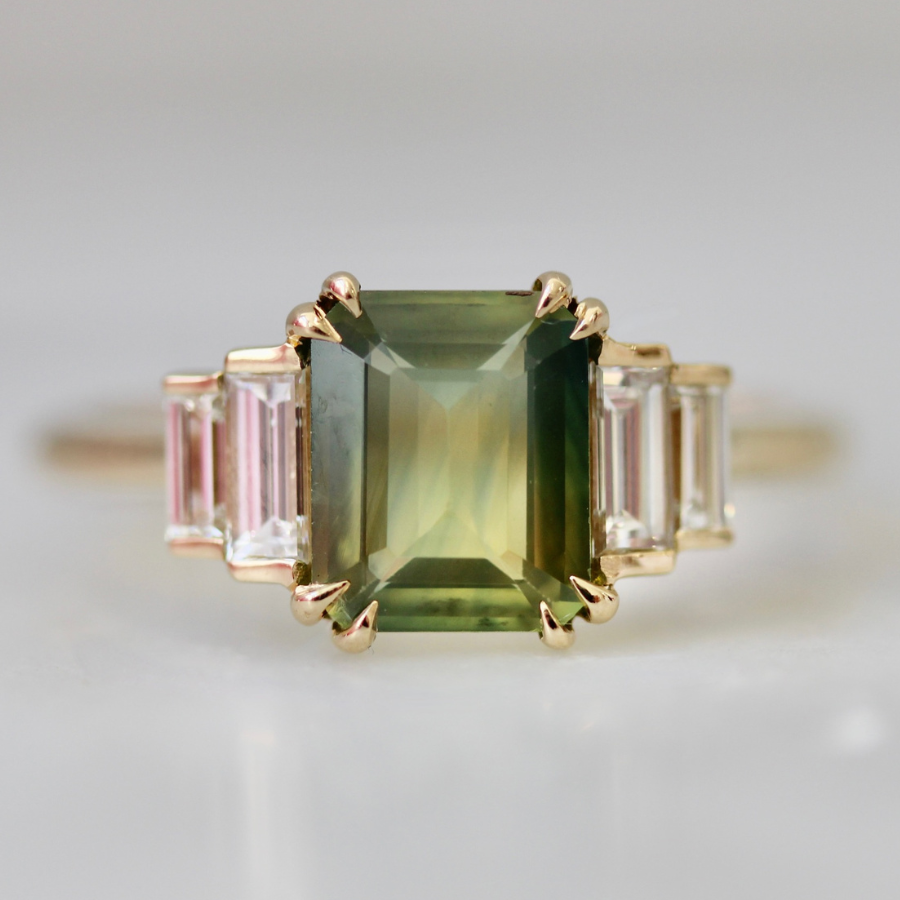
Green. Less discussed but worth knowing. A true green sapphire has a depth that emeralds match in intensity but not in daily wearability. Green sapphires offer that color without the fragility, which matters for daily-wear pieces.
The Pricing Reality
The old story was that non-blue sapphires were uniformly cheaper than blue. The current story is messier and more interesting.
Blue itself has a wider range than most shoppers remember. Fine & Flux’s 2025 retail guide puts 1-carat blue sapphires at roughly $800 to $1,000 per carat for light blue, $1,000 to $6,000 for medium blue heat-treated, $4,000 to $7,000 for royal blue heat-treated, and $5,000 to $10,000+ for royal blue unheated. In the middle of that range, blue is not automatically more expensive than a colored sapphire at the same designer.
Inside the non-blue world, the color-by-color reality is uneven. Teal is now a premium. Yellow is still cheaper per finished piece than the rest of the category. Lavender is priced higher than its qualitative demand because the supply chain is small and the untreated marketing story lets sellers justify it. Peach holds steady below padparadscha. Parti varies widely by cut and origin because nobody has really set the market on it yet.
The practical read: a $2,000 to $3,000 budget buys a more interesting piece in yellow, parti, or a careful peach selection than in teal or blue at the same price. A $3,000 to $5,000 budget opens up Montana teals, meaningful lavenders, and the better peach sapphires. And because inventory at independent jewelers tends to be one-of-a-kind rather than a standardized production line, what you find in any given month is partly a matter of timing.
Heat Treatment and Certification
Most sapphires on the market are heat-treated. The widely cited 90 to 95 percent figure is retail trade estimate rather than a current lab census, so treat it as directional. But the direction is correct: heating is industry standard. GIA’s own FAQ says plainly, “Heating is an accepted treatment for sapphire,” and GIA’s technical paper on ruby and sapphire heat treatment describes what heat does in practice: improves color, alters silk and asterism, reduces imperfections. Color and clarity both.
A heated sapphire is not a compromised sapphire. It’s a normal sapphire. What you pay extra for in an unheated stone is rarity, paperwork, and the knowledge that the color and clarity you’re looking at are natural. GIA says confirmation of “no evidence of heat” adds to “rarity and value,” which supports a premium but doesn’t define one. Current public sources don’t cleanly support the 15-to-20-percent-at-small-sizes figure that floats around jeweler blogs. The qualitative direction is safe; the specific premium number is not.
On certification, colored stone reports from IGI, GIA, and AGL all disclose identification and treatment status. The question most buyers care about (does the paperwork name the specific mine or deposit?) is trickier. Standard consumer-facing reports are typically clearer on country-level origin than on mine-level specifics. If you want Rock Creek provenance documented, the retailer’s own disclosure and supporting paperwork matter more than the generic existence of a lab certificate.
Montana Sapphires, More Carefully
“Montana sapphire” is doing too much work as a phrase. The honest version is narrower: Rock Creek has the clearest mine-level environmental and branding story in the category, and other Montana deposits are real and different.
Gem Breakfast’s 2025 interview with the Rock Creek mine operator (Potentate Mining) describes a water cycle where rainwater is collected for washing, used water passes through ponds and filtration, and the recycled water is required to be drinking-quality before release. Quoting the operator: “Any water released from the mining operation must be drinking quality.” That’s a sustainability claim at the level of a single mine, with numbers attached. GIA’s 2025 gem-news update says Potentate has developed Rock Creek into one of the pillar American sapphire sources on the global market.
By contrast, GIA’s 2023 characterization paper treats Rock Creek and Missouri River as distinguishable populations of Montana sapphire with different crystal forms and pebble characteristics. Missouri River tends to yield larger, higher-clarity stones; Rock Creek has its own output profile. Yogo Gulch is a third historical source, mostly a footnote in current retail.
Yogo is the romantic Montana story: a hard-rock deposit discovered in the 1890s that produced cornflower-blue sapphires set in a few Edwardian-era pieces and then more or less closed. Tiny current output, most of it locked up with collectors. A Yogo sapphire is the kind of thing a jeweler mentions the way a sommelier mentions a 1959 Bordeaux.
The practical consequence: if a retailer says “Montana sapphire,” ask which deposit. Rock Creek buyers can often get mine-level traceability. Missouri River or general-alluvial Montana material is usually described at country- or state-level only. Both origins are real; they’re just different stories, and a jeweler who can tell you which is which is doing the work.
How to Shop
The most important thing about buying a colored sapphire is seeing it in person, or at minimum in a high-quality video that shows the stone under multiple lighting conditions. Static photos lie about colored sapphires more than almost any other stone, because the color shifts are the whole point, and a single photo under one light captures maybe thirty percent of what the stone does.
If you can’t get in-person, ask for video under daylight, incandescent, and fluorescent. Serious independent designers will usually send it without being asked. (There’s a separate piece on how to tell if jewelry is well made if you want the broader list of what to ask about at the setting level.)
Ask the jeweler about origin. Rock Creek Montana is a specific thing with a specific story. Sri Lankan (also called Ceylon) sapphires tend toward lighter, brighter colors and excellent clarity. Australian sapphires run darker and more saturated. The origin affects the look, and knowing where your stone comes from is part of appreciating it.
Settings matter too. Bezel settings in yellow gold work particularly well with colored sapphires because the warm metal frames the color and the bezel protects the stone’s girdle. Prongs work too, especially for stones with exceptional color, because they let more light in and intensify the hue. Match the setting to the stone’s personality and to how you live.
A quick production note while you’re looking. Some of the independent designers here (Valerie Madison, for example) disclose four to six weeks for fine jewelry and eight to ten weeks for custom engagement rings. Independent designer timelines aren’t bugs, they’re how the pieces get made. Plan accordingly, especially around gifts and engagements.
Pendants and Earrings, Since Rings Aren’t the Only Way In
If you want sapphires without the weight of “engagement ring” implications, pendants and earrings are where the category goes underrated.
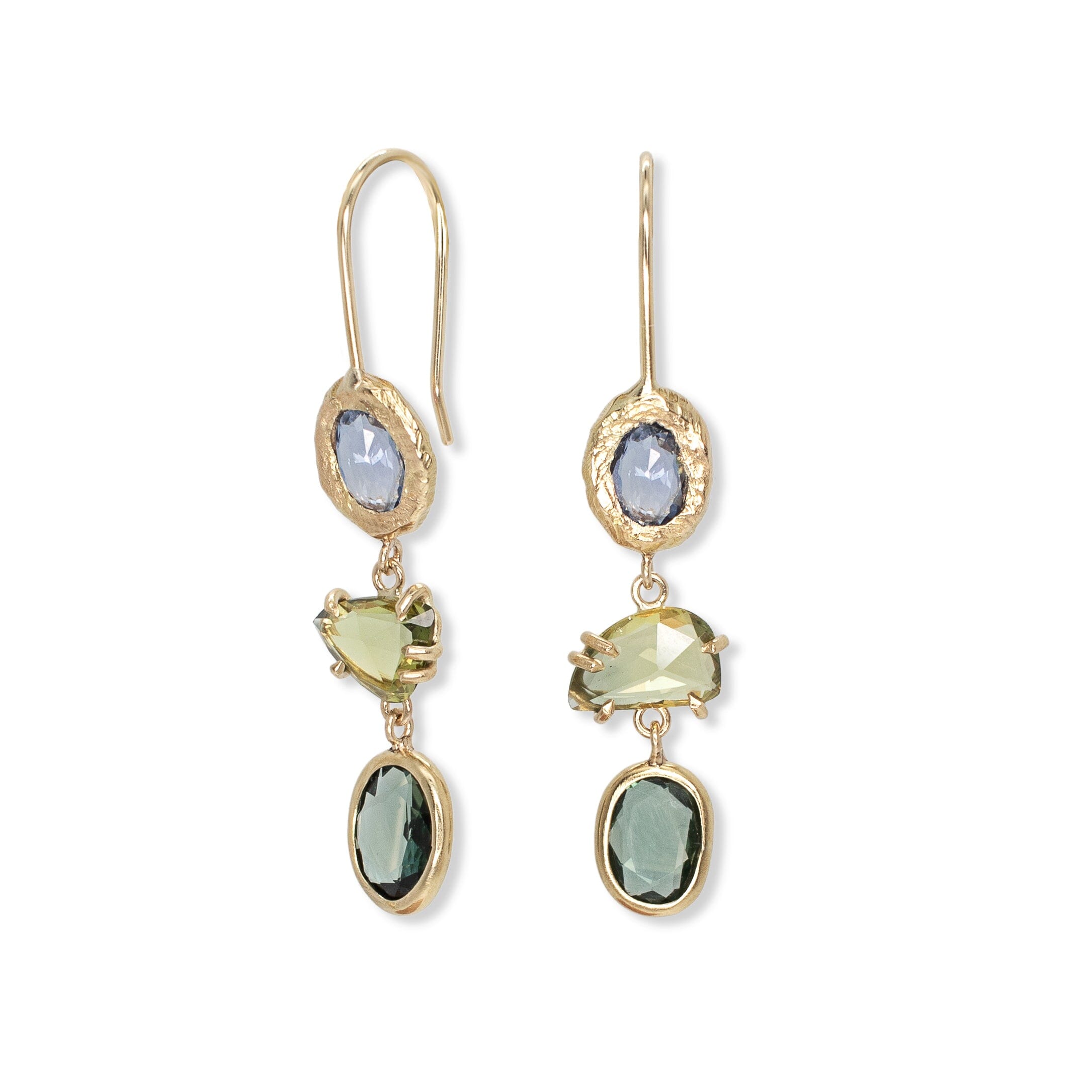
Page Sargisson (Brooklyn, 18k recycled gold, sapphire-heavy collection, rough-brushstroke metalwork she traces to her grandfather’s woodworking studio) is one of the most consistent non-ring sapphire sources in the market. The 18k freeform yellow sapphire charm pendant is $1,250. The 18k lilac purple sapphire freeform drop earring is $2,030. The 18k triple-drop earring in cool rainbow sapphires is $2,600. The aesthetic is unmistakable even across sparse SKU photography. InsideHook named the Boerum Hill store one of the best independent jewelers in New York in a 2024 guide; INSTORE profiled her January 2026 Madison Avenue expansion.
Bario Neal (Philadelphia, 100% recycled and Fairmined metals, ethically sourced stones) delivers a similar ethos with a different aesthetic. The Lash blue-green sapphire pendant in yellow gold is $1,320. The Hieros decagon sapphire and diamond pendant in yellow gold is $1,700. Custom blue sapphire cluster studs run $700 to $1,700. JCK covered Bario Neal’s sustainability packaging launch in 2024, and a 2024 Vogue holiday piece included an editor mentioning her own Bario Neal engagement ring.
J Albrecht Designs (Boulder, 18k premium recycled yellow gold, work made “outside of the crush of trend and algorithm,” in the brand’s own language) is smaller and harder to get live inventory on, but the Sapphire Sunrise earrings at $3,450 are a clean live example: 18k recycled yellow gold, 0.67 ctw greenish-blue Madagascar sapphires, 0.11 ctw diamonds, on French hooks.
Valerie Madison rounds out the short list. The sapphire and diamond baguette necklace starts at $1,245. Seattle-based, recycled metals, conflict-free stones, one of the few Black-owned fine jewelry houses in the country, and Jewelers of America named her to its 2025 to 2026 board.
Four designers, four aesthetics, same conclusion: if you want into the sapphire world at a serious price point, pendants and earrings give you optionality that the ring market, right now, doesn’t.
Why This Is the Window
The sapphire world beyond blue is wider, more varied, and more specifically priced than most shoppers realize. Teal has already been priced in. Yellow is still undervalued. Lavender is supply-constrained. Peach is interesting without being obvious. Parti is the color an attentive shopper is building around in 2026 before the broader market catches on.
Color is coming back across fashion generally. Durability is the reason sapphire wins the category inside that trend. And independent designers are where the pieces that express both are getting made.
The boring version of “buy a colored sapphire” is a blue solitaire from a big retailer. The better version is a yellow Page Sargisson charm, a bi-color Bario Neal custom pendant, a Rock Creek teal from Gem Breakfast, or a Valerie Madison pear-cut peach that catches your eye. Same stone category, same durability, wildly different pieces. Bring a new color to your life and see what happens.
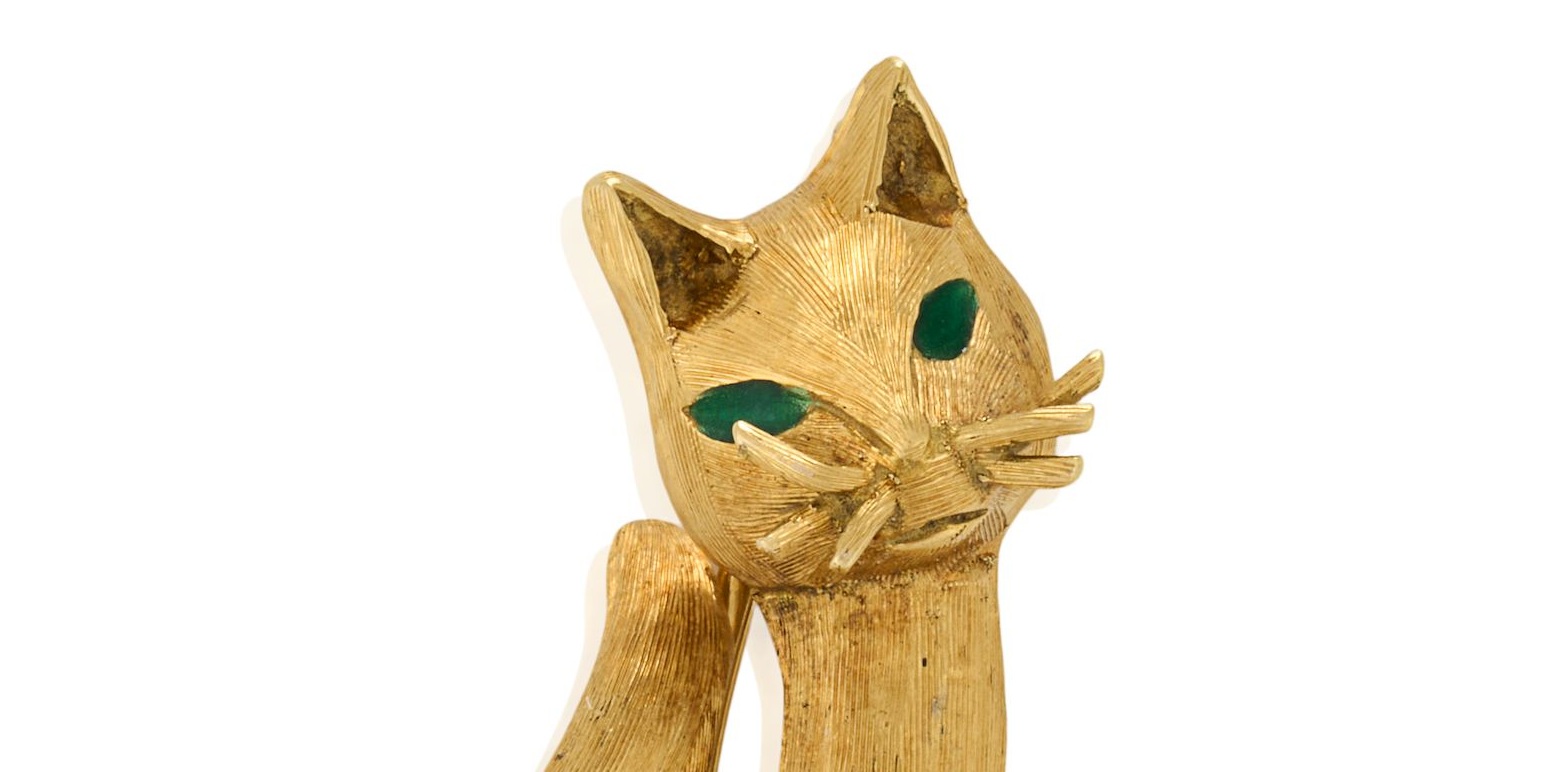
Sandy Lerner Is Rehoming Her Cats: A Tiffany Cat Brooch and Sixty-Five More
The Cisco co-founder spent four decades collecting cats in gold, enamel, amethyst and bronze. On 30 September 2026 Bonhams sells 66 of them in New York, from a $700 carved cat to a $120,000 bronze by the sculptor Rembrandt Bugatti. She is keeping the live ones.
Why Are Jewelry Prices Still Going Up?
Jewelry costs about 15% more than it did a year ago, and it is the gold accounting for most of it. The answer coming back from the jewelry trade and brands is less gold in the piece, which changes what you have to ask for at the counter.
Natural Diamond Prices Are Going Up Again, at Least for Now
Lab-grown stones pushed mined diamond prices down for years. The diamond trade's price index rose again in August, led by small stones. What that changes for you.
The newsletter.
One email when something is worth your attention. New essays, the buying calls behind them, and what we’re watching in the trade. No roundups, no affiliate dumps.