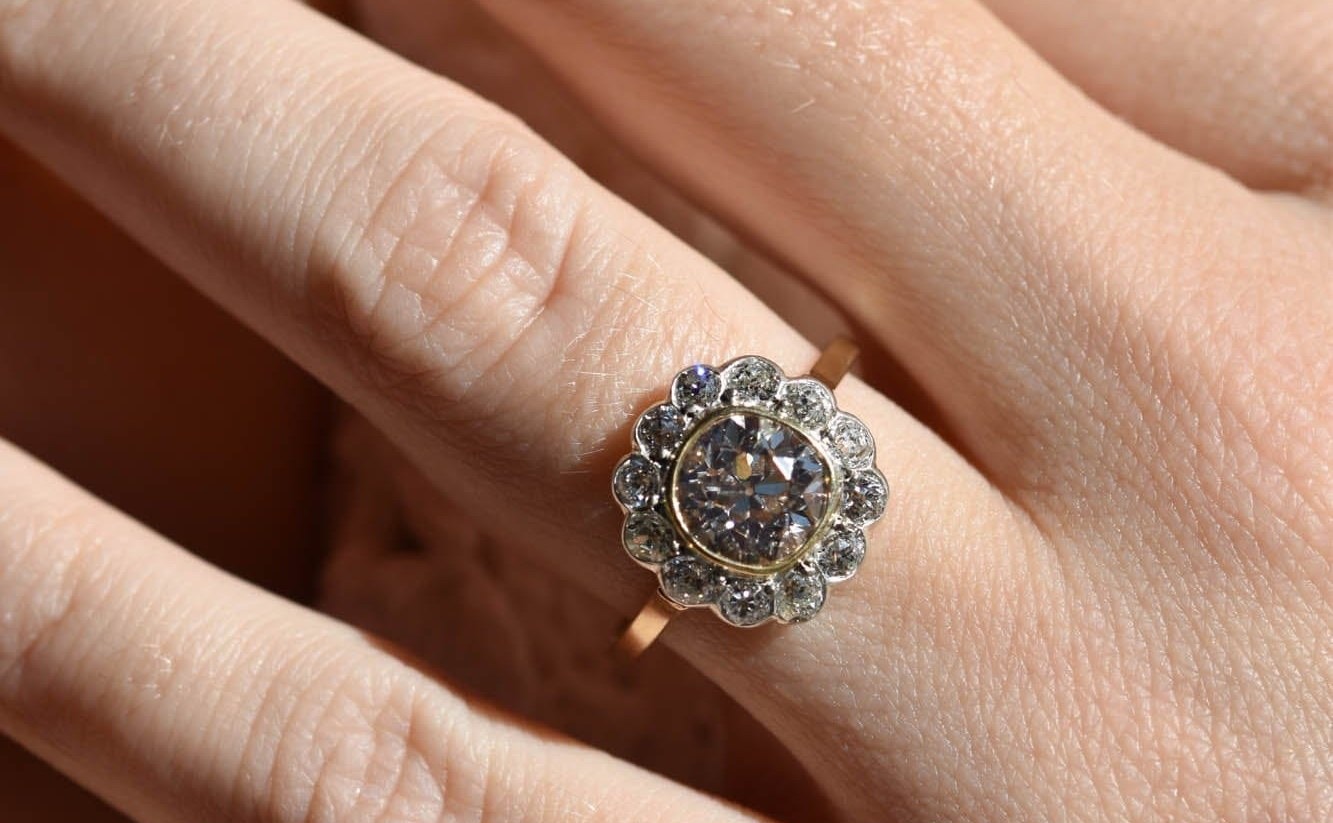
Photo: Erstwhile Jewelry
Old Mine Cut Diamonds: Why the Vintage Cut Is Worth the Search
An old mine cut diamond reads differently from a modern round brilliant: warmer, slower, candlelit. What this vintage diamond cut is, why fine jewelry buyers are chasing it, and what it really costs.
A modern round brilliant diamond is engineered to do one thing very well: bounce light back at you with maximum intensity. The result is a precision instrument. Fifty-seven or fifty-eight facets, mathematically optimized, designed to create that characteristic flash of brilliance. Under any lighting, it sparkles, and it sparkles aggressively. It’s trying to be noticed, and it succeeds.
An old mine cut diamond does something different. The facets are larger, fewer, and cut by hand rather than by machine. The table, the flat facet on top, is smaller; the crown, the sloped section just below it, sits taller; and the pavilion, the cone underneath, runs deeper. And instead of that tight, white, look-at-me brilliance, it produces broad flashes of fire, colored light that moves slowly as the stone turns. Put it in a restaurant under candlelight and it glows, like something designed for rooms lit by fire rather than fluorescent tubes.
The glow is the whole appeal, and right now a lot of people are discovering it for the first time.
What Changed
When Travis Kelce proposed to Taylor Swift, the ring he chose became, almost overnight, the most-looked-at diamond in the world. The couple announced the engagement on Instagram on August 26, 2025, and within days the stone had a label attached to it that most people had never heard. GIA, the lab that grades most diamonds, described it as “what is believed to be an old mine cut diamond.” It’s the work of Kindred Lubeck of Artifex Fine Jewelry: a warm-toned, bezel-set antique stone on a gold band, roughly eight to ten carats by expert estimate. The terminology stayed slightly hedged, the way it tends to when there’s no public grading report, but the cut was clear enough to send a cohort of people who had never thought about faceting straight to a search bar.
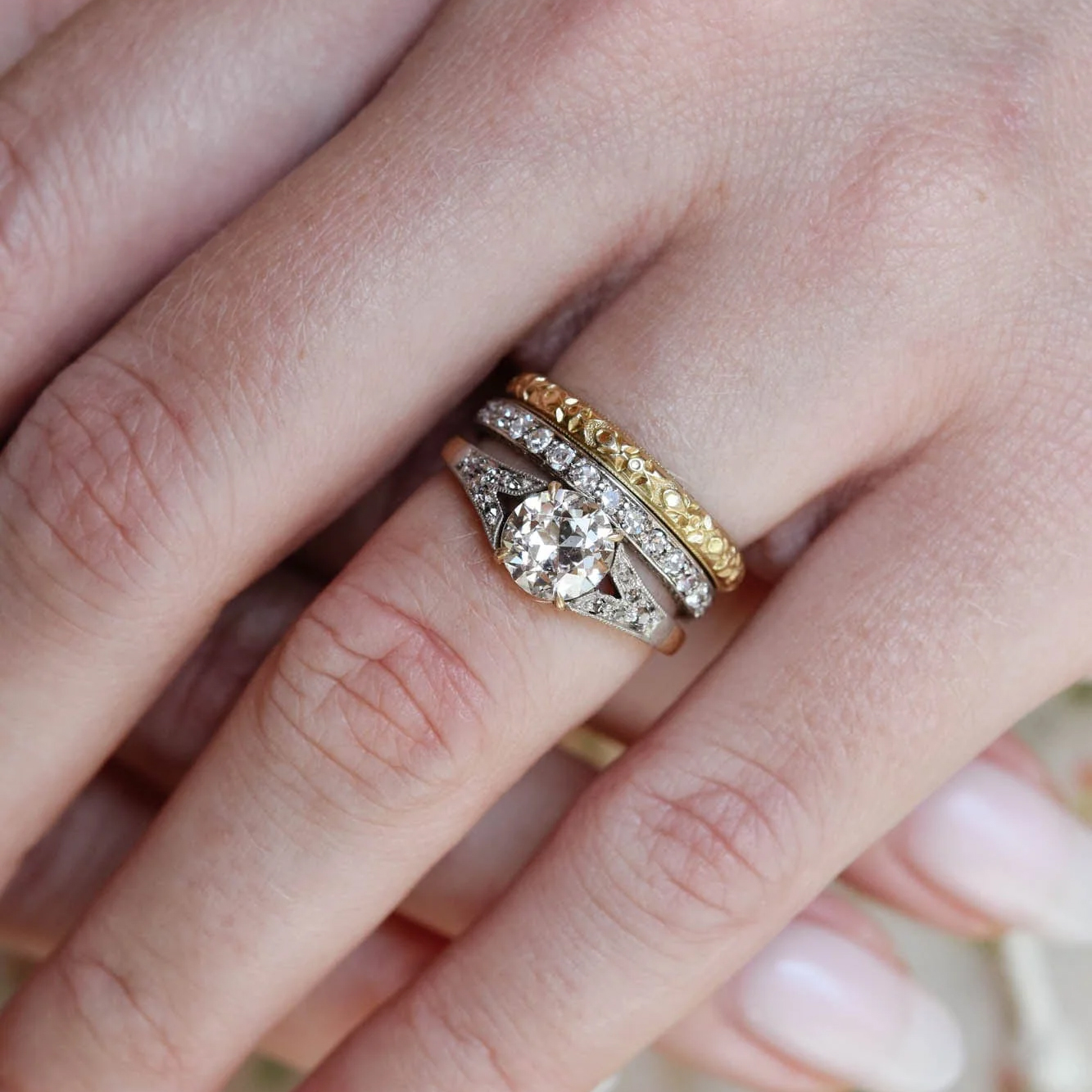
And the searches spiked, hard. Within days the cut went from a term most people had never heard to one of the most-looked-up diamond shapes of the month, and the old, slow inventory jewelers had been sitting on was suddenly in demand overnight.
But the interest was building before the ring, and much of it was bridal. Jack Weir & Sons, a vintage jewelry dealer, named old mine diamonds one of the five defining styles of 2026 and wrote that “the ascent of Old Mine cuts most clearly embodies 2026’s hunger for authenticity and individuality.” Trumpet & Horn reported couples shopping for an engagement ring “increasingly drawn” to antique cuts and framed the appeal in one line that doubles as a thesis for the whole movement: “Choosing vintage often means choosing character over perfection.” The Swift ring accelerated all of this. It didn’t create it.
What created it is a backlash against uniformity. Modern diamonds are spectacular, but they all look the same. A one-carat round brilliant from Brand A and a one-carat round brilliant from Brand B, at the same grade, are almost indistinguishable. That’s the point of modern cutting: consistency. And for a generation that grew up being told to value individuality and imperfection (in clothing, in food, in furniture, in everything except somehow diamonds), the perfectly uniform stone started feeling like a contradiction.
An old mine cut is, by its very nature, one-of-a-kind. No two were cut the same way because they were all cut by hand, by individual craftsmen, working under candlelight, trying to save as much of the rough stone as possible. The asymmetries and imperfections are the signature of a hand-cut stone, the proof a person made it. And that shift in perception, from “imperfect” to “characterful,” is the taste movement underneath the trend. The same instinct turned brown diamonds into a story and pulled pearl jewelry toward big, irregular baroque shapes. White, flawless, and uniform stopped being the only definition of beautiful.
What You’re Looking At
Old mine cut diamonds are generally cushion-shaped (rounded square) with a few distinguishing features that you can learn to spot.
Start with the culet. In a modern diamond, the bottom comes to a sharp point, but an old mine cut has a flat facet down there, large enough to see through the top of the stone, where it looks like a tiny window at the center. Some people find it distracting the first time they see it, and most find it charming once they understand what they’re looking at. Look at the stone from the side and you’ll notice the crown sits taller than a modern cut, and that height is what gives old mine cuts their depth and their particular way of handling light. Then there’s the faceting: a modern round brilliant carries 57 or 58 small, precise facets, while an old mine cut works with fewer and larger ones that throw bigger flashes of light. Think of it as the difference between a strobe light and a candle. The strobe is more intense. The candle is more beautiful.
Think of it as the difference between a strobe light and a candle. The strobe is more intense. The candle is more beautiful.
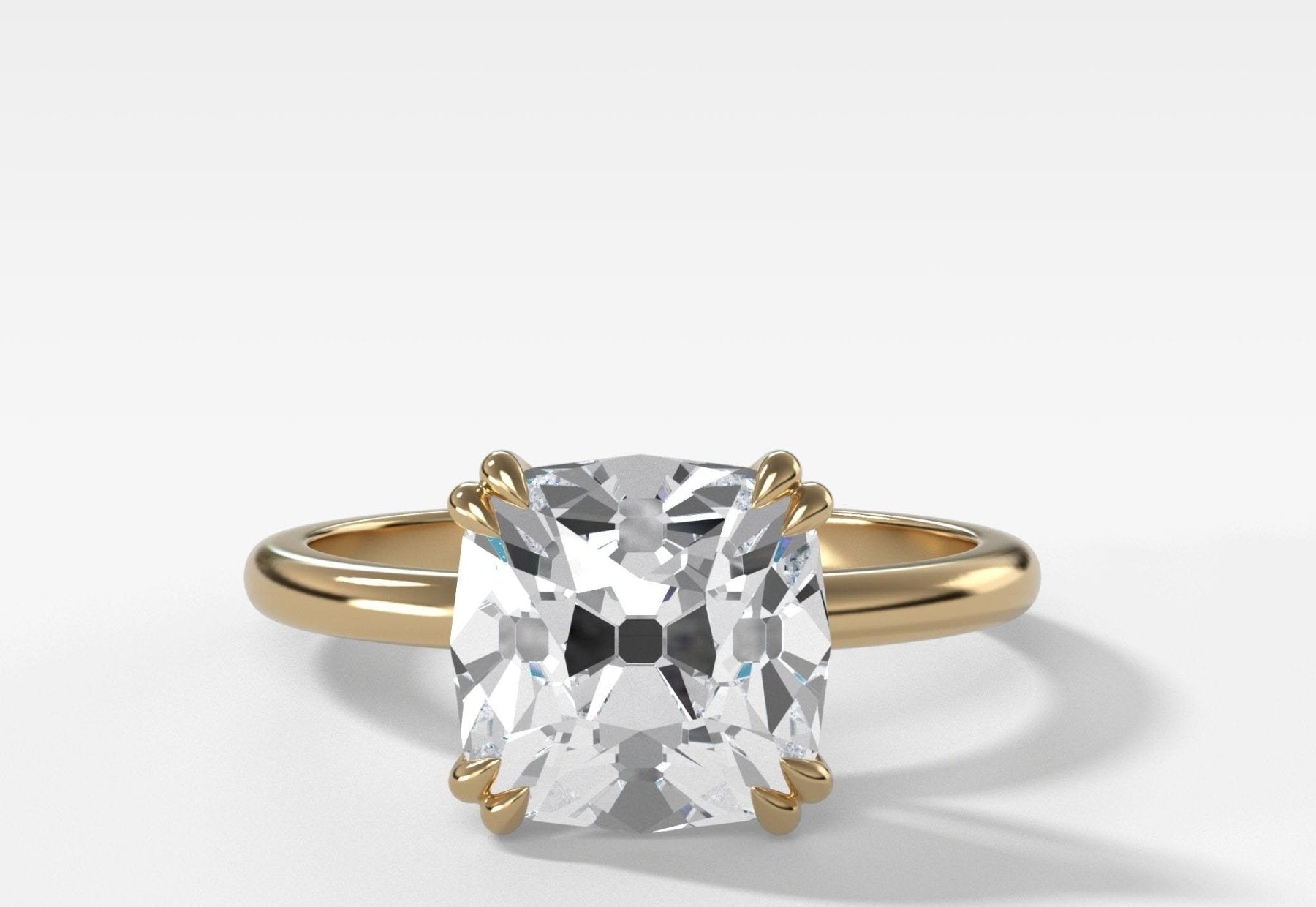
Those big, flat facets are also a maximalist move, part of why a century-old cut reads as current: more open surface, less fussy detail. A modern brilliant chops light into dozens of small, precise points; an old mine cut works in a few broad planes, the same instinct now pulling fine jewelry back toward bigger, bolder pieces and away from the small, careful sparkle of the quiet-luxury years.
The Price Conversation
Old mine cut diamonds confuse people on price because they get judged by a system built for modern stones. GIA grades cut around the modern round brilliant, scoring it across a fixed set of components, and an old mine cut doesn’t slot neatly into that machine. It will lose on most of those metrics, because the metrics were built to reward exactly the things an old mine cut isn’t trying to do.
The intuitive conclusion is that this makes old mine cuts cheaper, and you’ll see that claim repeated, often as a tidy “20 to 40 percent less.” The current market doesn’t really support it. True antique old mine stones in the one-to-two-carat range are scarce, and the finished, certified pieces that do surface can carry a premium rather than a discount. A Jack Weir & Sons listing on Chairish, a one-carat old mine cut ring in 18k gold, runs $4,800. A comparable one-carat modern round at Blue Nile, a midrange grade at J color and SI2 clarity, runs around $1,690. That’s the old stone costing almost three times as much, because it’s a finished, story-heavy object and the modern stone is a commodity priced off a grid.
Where the bargain version of the story holds up at all is with antique-style reproductions: modern stones cut in the old manner. A 1.71-carat reproduction old mine listed at $4,495 comes in roughly 13 to 24 percent below similarly sized modern rounds. That’s real, but it’s a different object than a hundred-year-old hand-cut diamond, and it’s worth knowing which one you’re paying for.
So the honest line is that old mine cuts are simply hard to price by the modern rules. The retail infrastructure is built for standardized rounds, while antique old mines circulate as individual objects, each one evaluated on its own, which is exactly why the people who love them love them. What you carry home is the object itself: the history in it, the one-of-a-kind stone that exists nowhere else.
Some dealers re-cut old mine diamonds into modern shapes to capture a different price, and this is real and documented. Jewellery Business describes recutting as a defining feature of the late-20th-century market, and the trade has long called the old mine cut a prime target precisely because its high crown and deep pavilion make it easy to refashion into a round brilliant. That is part of why so many of the whiter antique stones are simply gone, recut decades ago. There’s a fair version of this: a stone so chipped or poorly fashioned that recutting is a rescue rather than an erasure. Recutter Uri Uralevich has noted that good antique dealers often repair an old miner and return it to its original mounting rather than convert it. But recutting for arbitrage, taking a 150-year-old hand-cut stone and turning it into a modern round for a few thousand dollars more, is a loss. If you’re buying an old mine cut, buy it because you love the cut. Don’t let anyone suggest re-cutting it.
Where to Find Them
Old mine cut diamonds are, by definition, old. They’re not being manufactured. The supply is finite, which means you’re shopping estate jewelry, antique dealers, and the handful of fine jewelers who specialize in curating vintage stones and setting them in modern mountings. Trumpet & Horn specializes in antique and vintage engagement rings with old mine cuts. Estate sales, high-end consignment shops, and auction houses are all potential sources, though these require more knowledge to navigate confidently.
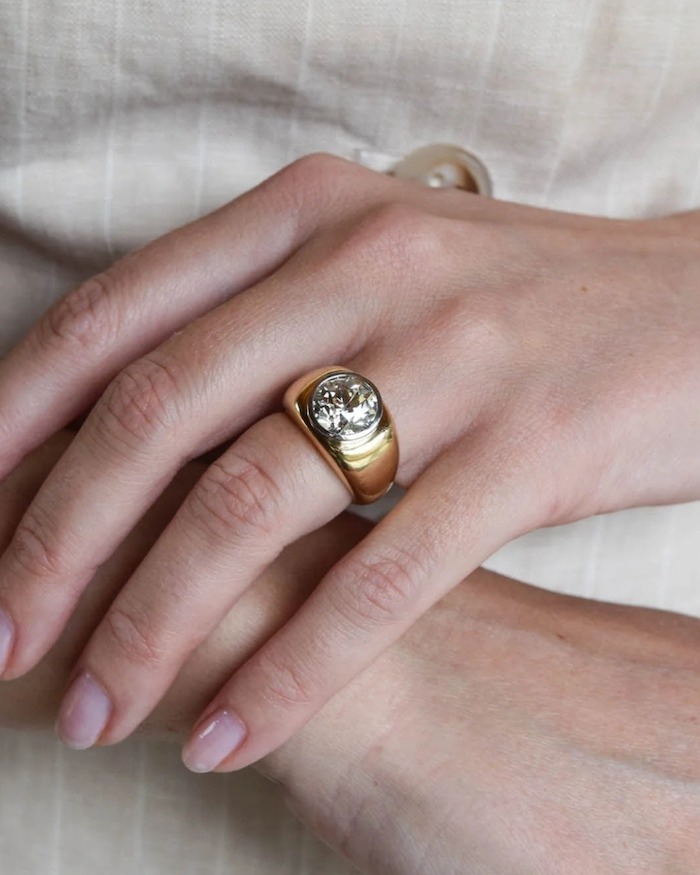
A word on one name you’ll find quickly. GOODSTONE runs a sizable old mine cut collection, more than forty styles, with rings starting around $1,925 and running past $4,800, and custom work generally beginning at $2,500. It’s a real and well-made option, but read the fine print on what it is: GOODSTONE’s old mine collection spans “both lab-grown and naturally sourced options,” and the brand is explicit that “lab-grown old-mine-cut diamonds give you the vintage look at a more accessible price point.” That makes it a cut-shape collection. No antique stones are involved. If what you want is the look of an old mine in a new ring with lifetime care behind it, that’s a clean, ethical way to get it. If what you want is a stone that was cut by hand a century ago, that’s a different search, and you’ll be doing it at the dealers and estate sources above.
The shopping experience for a true antique is different from buying modern. You’re evaluating individual stones, each with its own personality, looking for the one whose particular combination of color, fire, and asymmetry appeals to you. It’s the same way you’d shop for a colored sapphire, where the exact teal or peach of one stone is the whole reason you want it. You’re closer to buying art than buying a commodity, and that turns out to be most of the appeal.
The Taste Argument
The old mine cut is having a moment because it represents a taste position. Choosing one says something about what you value: warmth over brightness, character over consistency, history over novelty. It says you care about how a stone feels rather than how it grades.
None of which makes modern brilliants wrong. They’re extraordinary feats of engineering. But the old mine cut offers something they don’t: the evidence of a human hand, and that counts for more every year that lab-grown diamonds get cheaper and more perfect. A machine can grow a flawless stone for a few hundred dollars now; what it can’t grow is the hand that turned a rough crystal by eye and decided where each facet would fall.
That stone in your ring may have been cut in a factory, but it was a factory lit by candlelight, probably in Antwerp or Amsterdam, probably a hundred years ago, by someone whose name nobody remembers, but was probably Cornelis or Dirk. And when you hold it up to a candle now, it does exactly what it was designed to do.
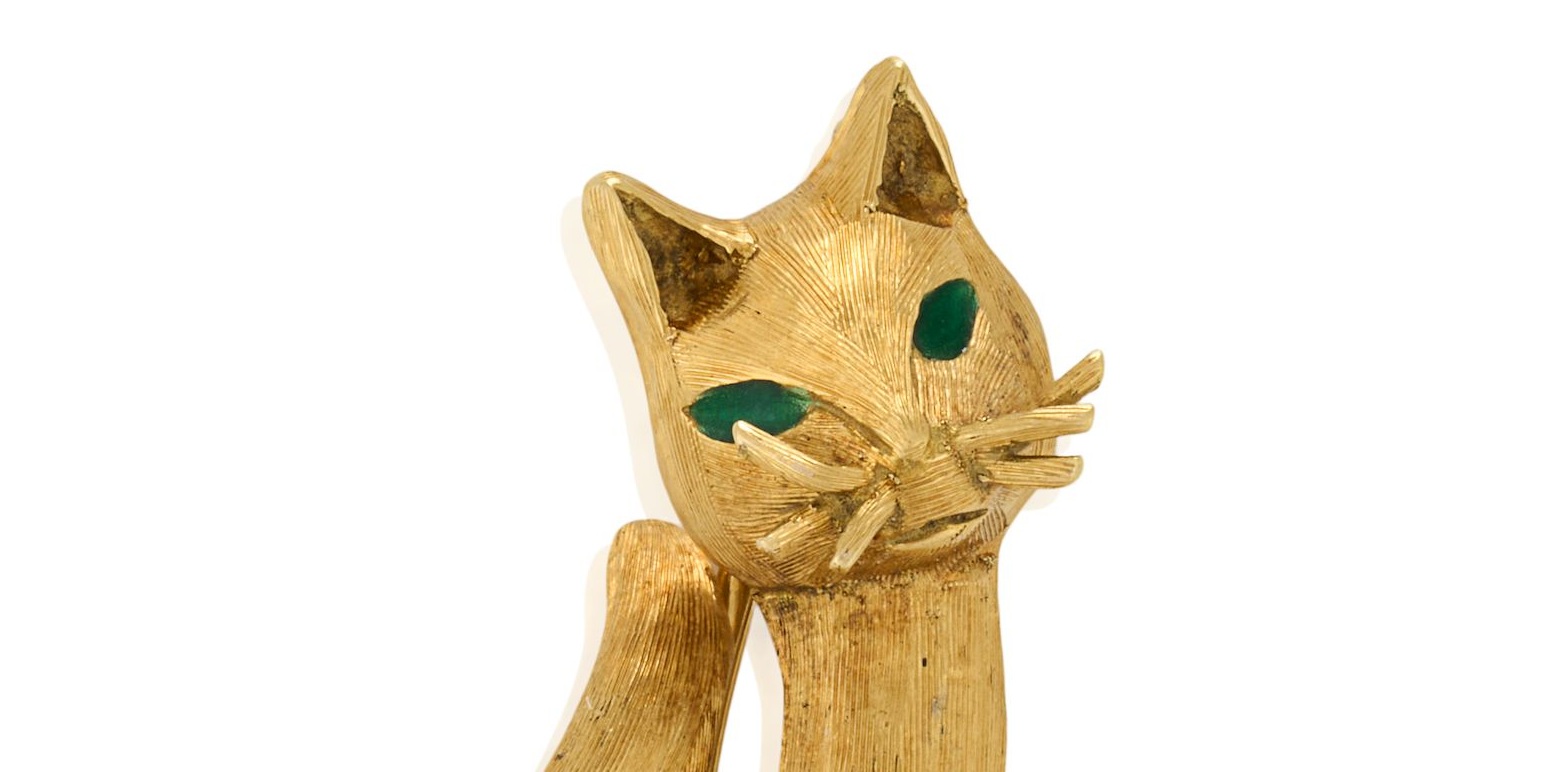
Sandy Lerner Is Rehoming Her Cats: A Tiffany Cat Brooch and Sixty-Five More
The Cisco co-founder spent four decades collecting cats in gold, enamel, amethyst and bronze. On 30 September 2026 Bonhams sells 66 of them in New York, from a $700 carved cat to a $120,000 bronze by the sculptor Rembrandt Bugatti. She is keeping the live ones.
Why Are Jewelry Prices Still Going Up?
Jewelry costs about 15% more than it did a year ago, and it is the gold accounting for most of it. The answer coming back from the jewelry trade and brands is less gold in the piece, which changes what you have to ask for at the counter.
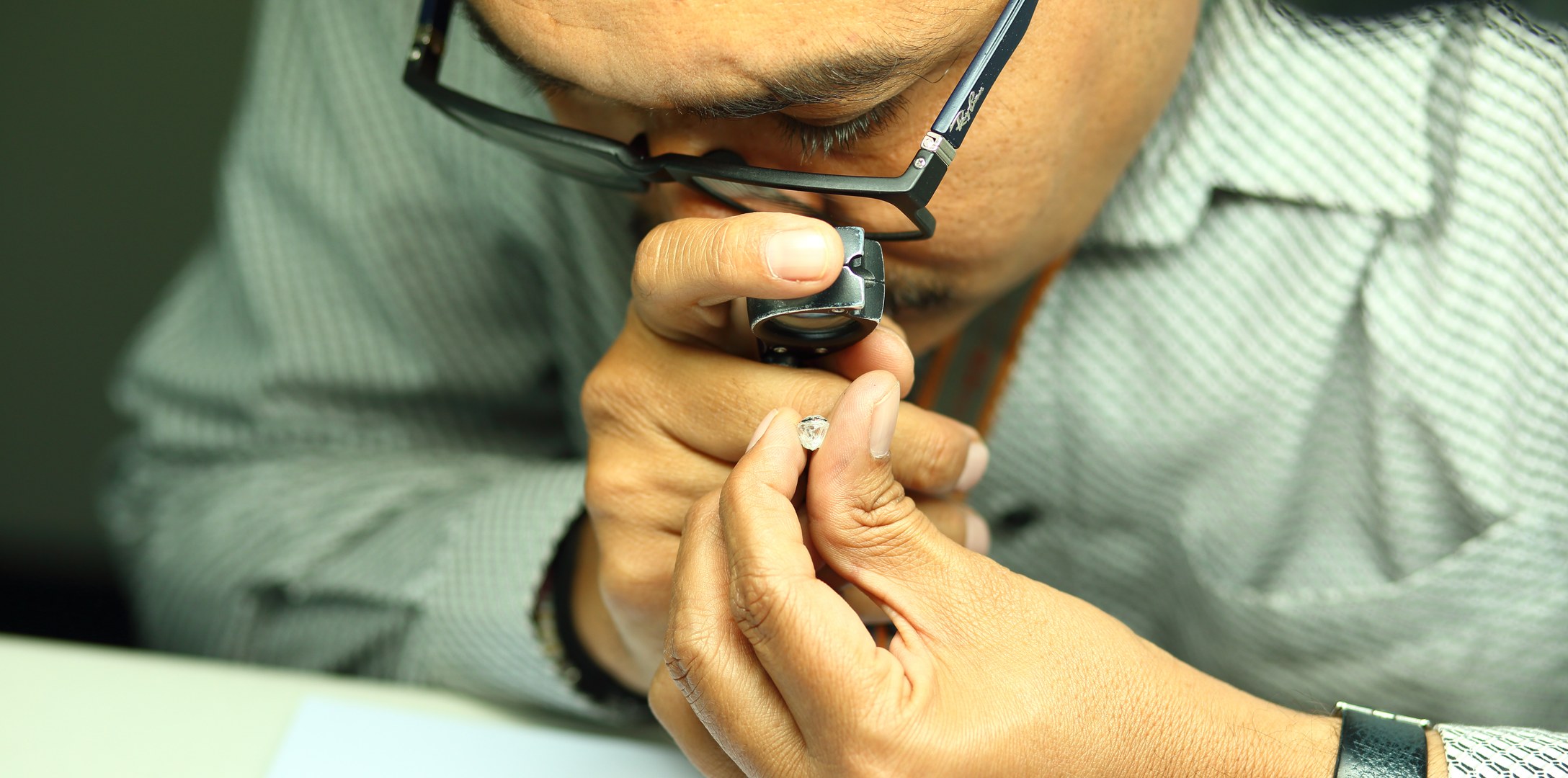
Natural Diamond Prices Are Going Up Again, at Least for Now
Lab-grown stones pushed mined diamond prices down for years. The diamond trade's price index rose again in August, led by small stones. What that changes for you.
The newsletter.
One email when something is worth your attention. New essays, the buying calls behind them, and what we’re watching in the trade. No roundups, no affiliate dumps.