The Medallion Is Back (and It Looks Nothing Like 1978)
The men's medallion is back in 2026 with a completely different silhouette than the disco-era original. What's worth buying at Foundrae, Miansai, and David Yurman, and why the best option might be a Napoleon III saint medal.
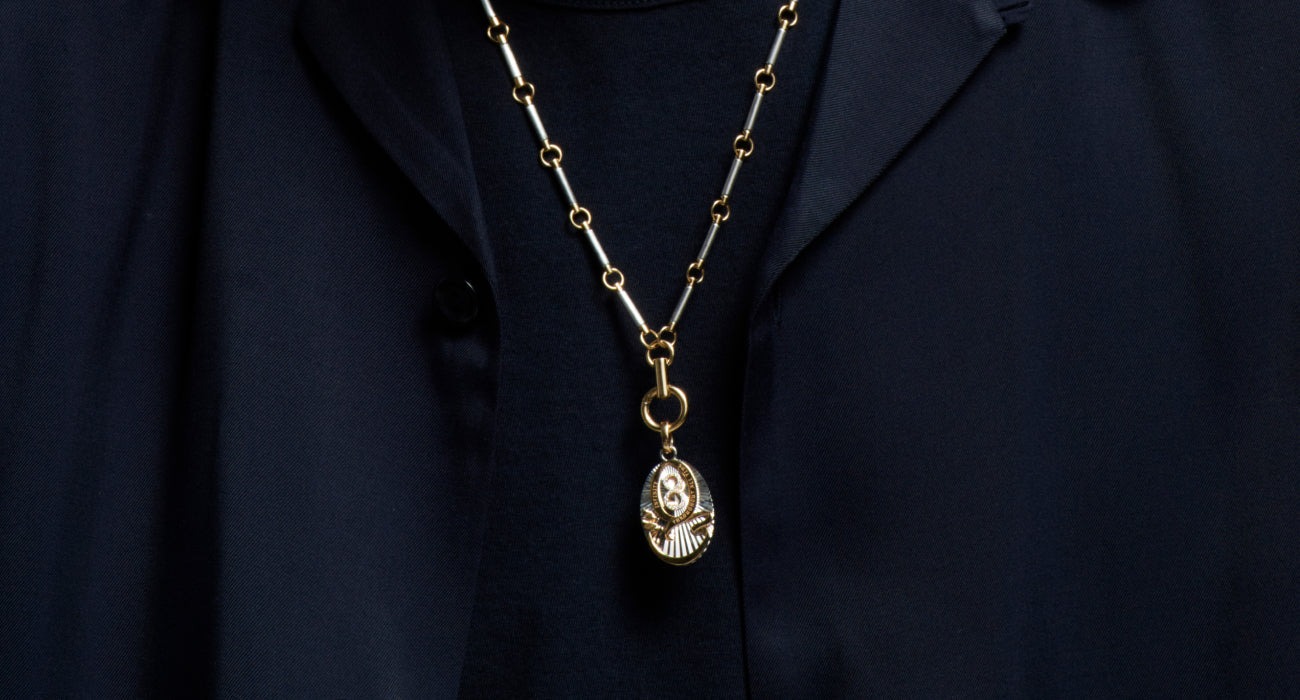
Laurel and I were leaving one of those restaurants that had become the place to be seen on a recent Saturday night. It was 10pm and the room was doing exactly what it was supposed to do: women in Givenchy, men who looked like they’d thought about it. A guy was walking in with his date, wearing a black woolen turtleneck, a black blazer, and a single silver medallion that sat just barely above his heart. Maybe two inches across. It looked clean. It drew your eye right to him.
That’s the version of the men’s medallion that matters in 2026, and it reads nothing like the last time a version of this object was culturally dominant. If you came of age remembering medallions as an open-shirt, chest-hair, disco-era artifact, the recalibration is going to take a minute.
The shape of the 2026 medallion
The 1970s medallion was a thin snake chain, a big hammered pendant, an open shirt, and chest hair. It was flash. It was mocked within a decade, and by the 90s it was dead. The silhouette of the 2026 medallion is the opposite.
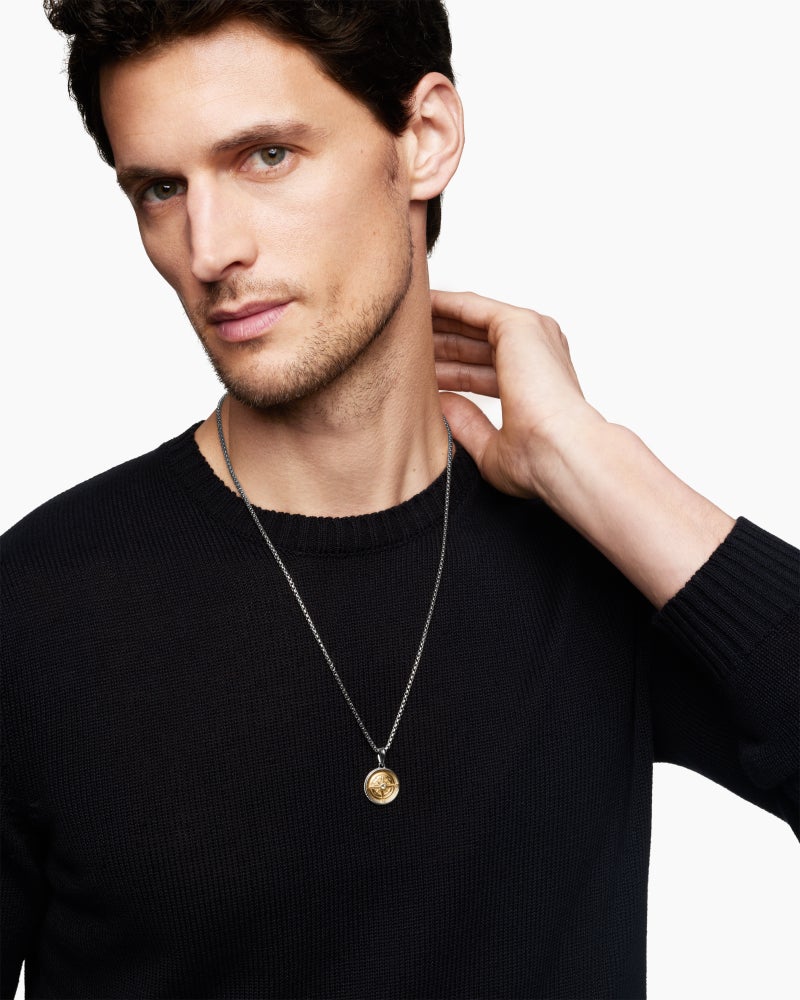
Heavier chain, smaller pendant, closed collar or crewneck, nothing showboating about any of it. The chain is usually a 3 to 4mm solid gold curb, box, or rolo, 20 to 24 inches, sitting roughly at the sternum. The pendant is 15 to 28mm across (Foundrae’s own size guide benchmarks the three core tiers at 15mm, 20mm, and 28mm, with a U.S. quarter as the reference object), often textured or hand-engraved rather than mirror-polished. The piece is visible when the shirt is open and subtle when it’s closed. A man wearing one in 2026 wears the same piece of jewelry every day, the way another man wears the same watch.
That’s the shift. Medallions used to be about the object. Now they’re about the person wearing the object, which is what fine jewelry has always been about anyway.
Why now
Two things have happened at once. The first is that men’s fine jewelry, as a category, has gotten serious. Pendants are among the fastest-growing parts of it, and the trend inside the trend is pendants worn as personal totems rather than decorative additions to a chain.
The second is the culture. Over the last two years a version of this same object has moved through red-carpet and editorial press photography often enough that it now reads as part of the modern men’s-jewelry vocabulary rather than a costume choice. Not every sighting attributed online is verifiable at the level of event, date, and photographer, but the pattern has become hard to miss.
Then there’s the lawsuit. On February 17, 2026, Foundrae’s parent company, Cemayla LLC, sued Pandora in the Southern District of New York for willful copyright infringement over Pandora’s Talisman collection, a 12-medallion line that debuted in August 2025. The filing (Cemayla, LLC v. Pandora Jewelry LLC et al., 1:2026cv01331) goes beyond the design of the medallions themselves. It targets Pandora’s marketing presentation, which Foundrae describes as “so reminiscent of FoundRae’s aesthetic” that customers reached out to the brand directly to ask if there was a connection. Foundrae’s CEO, Ruth Sommers, put it in the complaint’s accompanying statement: “Every design we create is intentional, original…” Foundrae is asking for a jury trial, an injunction, and seizure and destruction of the disputed pieces.
The filing is the cultural marker. When the world’s largest jewelry company builds a 12-piece medallion line similar enough that a small house feels a reputational threat from its own customers, and goes to federal court over it, the category has arrived. Pandora doesn’t copy dead shapes.
The costume edge
A medallion is a high risk object in men’s fine jewelry. Worn well, it’s the single most confident piece a man can put on. Worn off, it flips instantly to costume, gaudy, and crass, and the line between confident and costume is thinner than any other piece of jewelry has to navigate.
The variables are real. A medallion on a chain that’s too thin looks like a dog tag. On a chain that’s too thick, it starts reading like a rapper borrowed it. At 24 inches or longer, on most men it drops below the second shirt button and starts to feel 1978. Polished mirror-bright yellow gold at a certain size tips into costume faster than a hand-textured or matte version at the same size. A 40mm medallion on most men is too big. A 15mm medallion starts reading religious rather than intentional, which can be fine if that’s what you mean. It usually isn’t.
The context matters as much as the object. A medallion under a crewneck, half-visible, is modern. The same medallion over a tight button-down with the top three buttons open is a costume. The same medallion on an open collar with a softly draped knit underneath is confident. The object hasn’t changed. The styling around it has.
Some men will look incredible in a medallion. Some men, including some who already wear a lot of jewelry, will not. That’s a real fact about a real object, and it’s more useful to the reader than a universal endorsement. The honest read: try one on, in the right scale and chain weight, with the clothes you actually wear, before buying. But the signal in 2026/2027 is clean and tight.
The houses defining the category
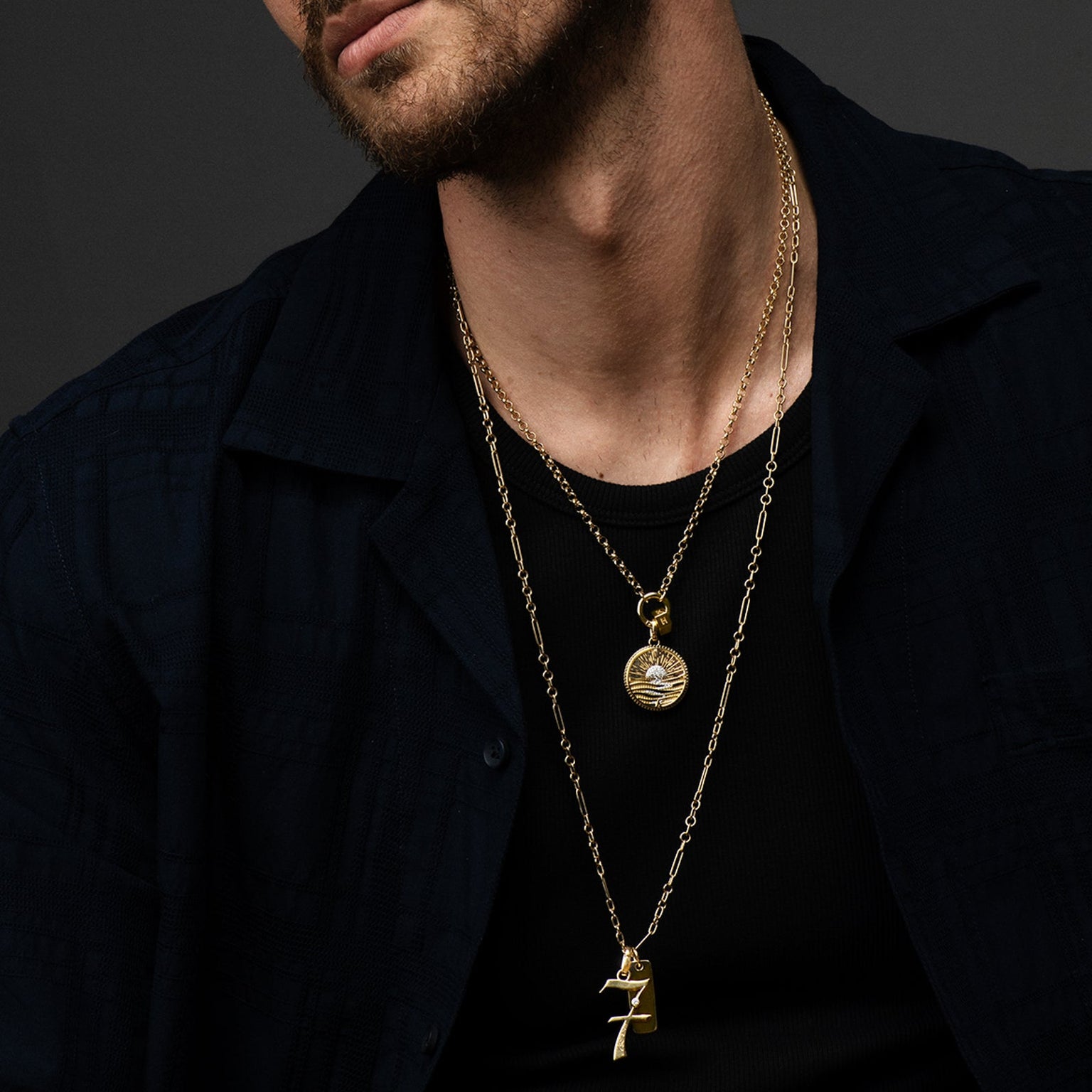
There are maybe five places worth starting. Each one has a recognizable signature, and the signatures are the reason people wearing them don’t look like they’re wearing the same piece.
Foundrae is the one that made this whole conversation possible. Founded in 2015 out of a Manhattan studio at 52 Lispenard Street, Foundrae builds medallions in 18k gold, almost always hand-engraved, with an internal symbolic vocabulary of tenets: resilience, wholeness, balance, and so on, each tied to specific imagery like the ouroboros or the crescent moon. The closure most associated with the brand is the Sister Hook, an interlocking-hook clasp the brand first introduced in 2021 and describes as adapted from Victorian watch fobs, and the Annex Link, a small decorative link that sits between the medallion and the chain. Entry medallions start around $1,650 for a 13mm emerald-set miniature, with the core baby-size pieces landing in the $2,250 to $3,600 range, and the heavier configurations pushing past $5,000. The trade-off is the very thing that makes Foundrae distinct. The symbolic system is readable to people who know it, which for some men is the appeal and for others is a reason to go somewhere else. A Foundrae medallion reads as a Foundrae medallion. Either you want that or you don’t. The other piece of friction is worth mentioning because the brand mentions it itself: the Annex Link is delicate, and Foundrae’s own product pages carry a warning not to twist it, because it will break. That’s either a refreshing piece of transparency or a daily operational tax, depending on your temperament.
Miansai is the cleaner architectural counterpoint. Founded by Michael Saiger in 2008 out of Miami, Miansai does solid gold coin pendants, signet-style medallions, and more restrained forms. Price points start lower, with solid 14k gold medallions like the Mini Dove beginning around $1,400, the Mini Saints around $1,500, and the full-size Saints and Dove necklaces landing at $1,950 each on 24-inch chains. That makes Miansai the house to look at if the medallion idea appeals but the Foundrae aesthetic doesn’t. The compromise is that Miansai’s sterling and vermeil pieces sit alongside the solid-gold ones in their catalog, and it takes a minute to sort what’s what. The solid-gold pieces are usually made to order, two weeks out, with a limited lifetime warranty.
David Yurman makes an Amulet line: pendants in blackened sterling with gold accents, or solid yellow gold, often with heraldic or Byzantine motifs. The line is widely retailed at DY counters, which is both the advantage and the trade-off. Availability and consistency are real. Ubiquity is also real. If you live near a David Yurman counter, so does everyone else.
Lionheart is a smaller name that comes up in Foundrae-adjacent “alternatives” discussions. The appeal is the price floor: some of the charms run around $900, which opens the door to a solid-gold piece at a third of the Foundrae equivalent. The trouble, per at least one firsthand account, is that the weight and diamond quality don’t match the expectation the price sets. One buyer described a Lionheart charm as “paper thin” with “horrible quality” diamonds. That’s community anecdote, not lab-verified quality reporting, but the word “paper thin” comes up for a reason. Lionheart is probably the discovery-level option to try on in person before buying remotely.
Independent goldsmiths and custom are the fifth option, and in some ways the most interesting one. A local goldsmith can make a single 18k medallion to the exact specs you want (scale, weight, finish, chain) for roughly what a retail piece costs, sometimes less. The trade-off is time. Expect months. And then there’s the cognitive overhead of designing the thing yourself. This route is not for a first medallion. For a second one, it might be the best answer.
The estate route
Men’s medallions are one of the few categories where vintage is often the strongest option on the table. The reason is that the old pieces were sized and weighted correctly by default. Nineteenth-century French saint medals, Roman and Byzantine coin pendants reset in modern bezels, Victorian love-tokens and memorial medallions, early-twentieth-century sporting medals: all of these were designed when medallions were a functional object. They weren’t built to photograph well. They were built to be worn.
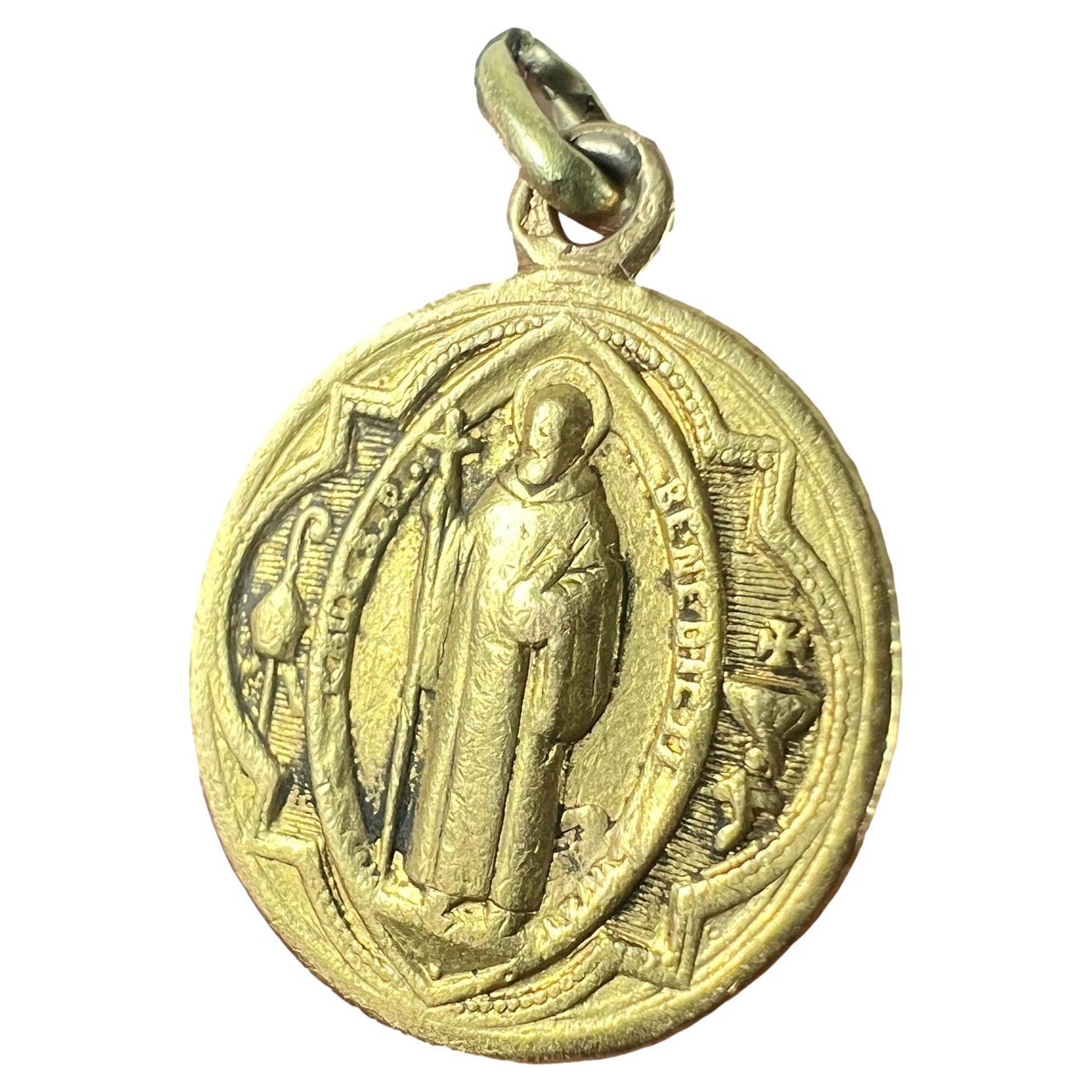
On 1stDibs, credible nineteenth-century French 18k saint medals in good condition tend to run a few hundred dollars to a few thousand, depending on maker, size, and condition. Ancient coin pendants set into modern gold bezels commonly cost more because the coin itself is the value. Victorian-era medallions of various types sit in a similar range, and the texture on them (wear, patina, hand-engraving that hasn’t been touched in 150 years) is impossible to replicate with new work. The specific price bands move with the market, so sample a few dealers before committing.
The medallion piece worth spending $3,000 on is much more likely to be a Napoleon III saint medal made 160 years ago than anything you can buy at a counter this afternoon.
Estate buying is its own skill. The secondhand guide covers most of the mechanics, but the short version for medallions specifically: you’re buying from a dealer, usually without trying the piece on, sometimes across borders, and the chain that comes with the medallion may or may not be the right one for you. Plan to buy the medallion and source the chain separately from a local jeweler. It’s almost always the right move.
How to buy one
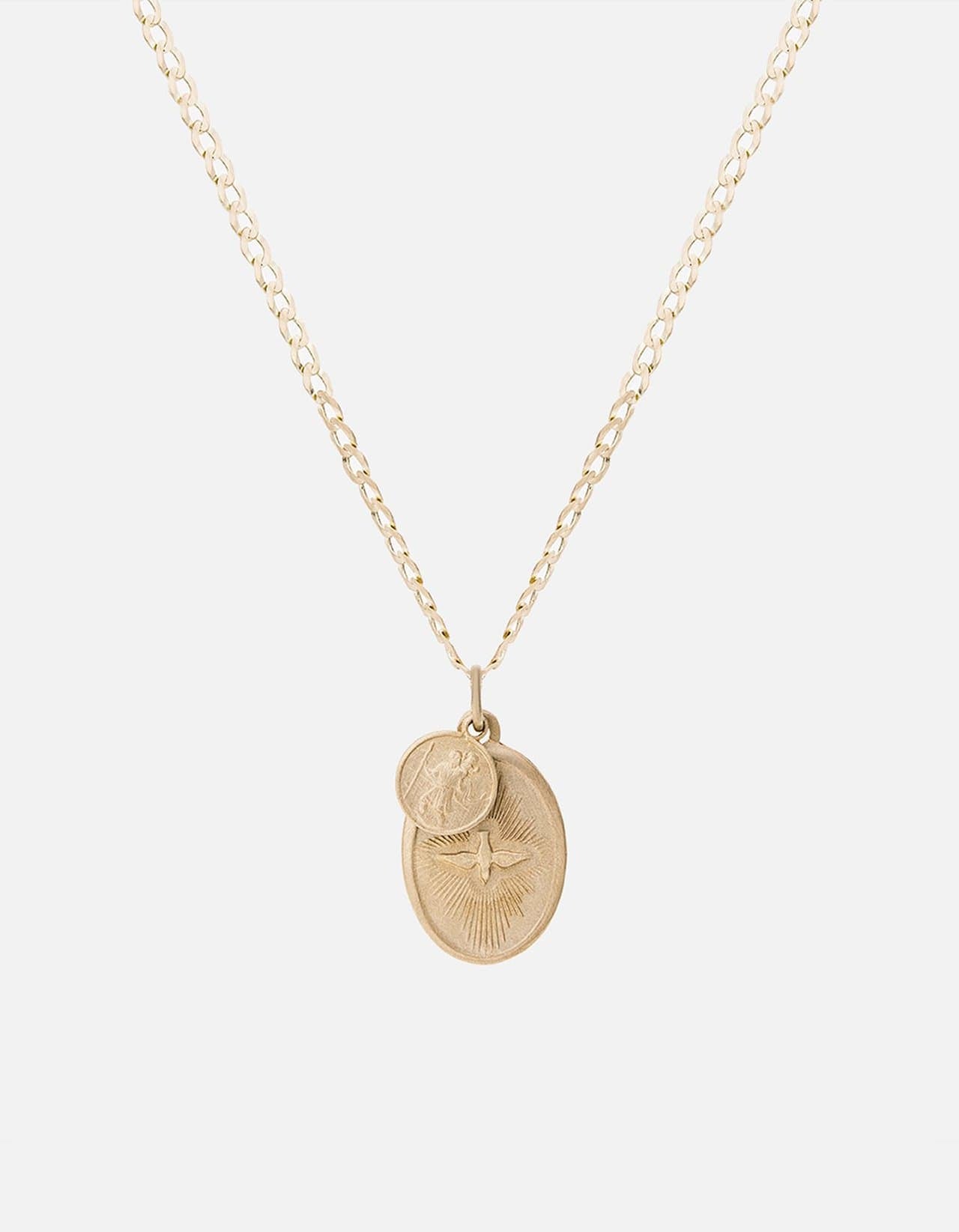
If this is your first serious piece of fine jewelry, a medallion is a confident choice. If it’s the sixth thing in your rotation and you have outfits to match, it still works.
Scale and chain weight first. Most men land on a 20 to 28mm medallion on a 3mm solid gold chain at 20 to 24 inches (Miansai’s Saints Necklace, for reference, runs 3mm at 24 inches). Try it in person if you can, and wear your actual clothes to the appointment. A medallion feels entirely different with a dress shirt than with a crewneck, and the salesperson will dress you up regardless of what you normally wear. Look at it in natural light, not counter lighting, which makes every gold piece look richer than it does outdoors.
Solid metal only, gold or silver. Skip plated and filled. Plating wears off medallions fast because of how the piece moves against the chest, and gold has been holding its value in ways that make the premium feel less like a splurge than it used to. The chain is the other half of the object visually, and it’s where cheap pieces tell on themselves. A thin, lightweight chain makes the best medallion in the world look insubstantial. Don’t minimize the pendant size to compensate for a light chain. A small medallion hides from the clothes around it and starts reading as a religious charm rather than a deliberate piece. Err larger, within reason.
One practical move before you buy: stand in front of a mirror in the outfit you wear most and use your phone camera from across the room to check the scale. What reads right in a counter mirror at arm’s length often looks too small from normal conversation distance, which is the distance that matters.
What it says
A man wearing a medallion in 2026 is signaling status in a different way than the 1978 medallion tried to. He’s showing that he made a specific decision, once, about an object he’s going to wear often to look better and attract attention, and he wore it today.
That’s what the best men’s clothing does. From a watch somebody chose carefully to a pair of fine shoes that are broken in, or a good overcoat. The men wearing one well are not trying to look like the men at the next table. They want to look like themselves, sometimes with one additional specific choice made visible.
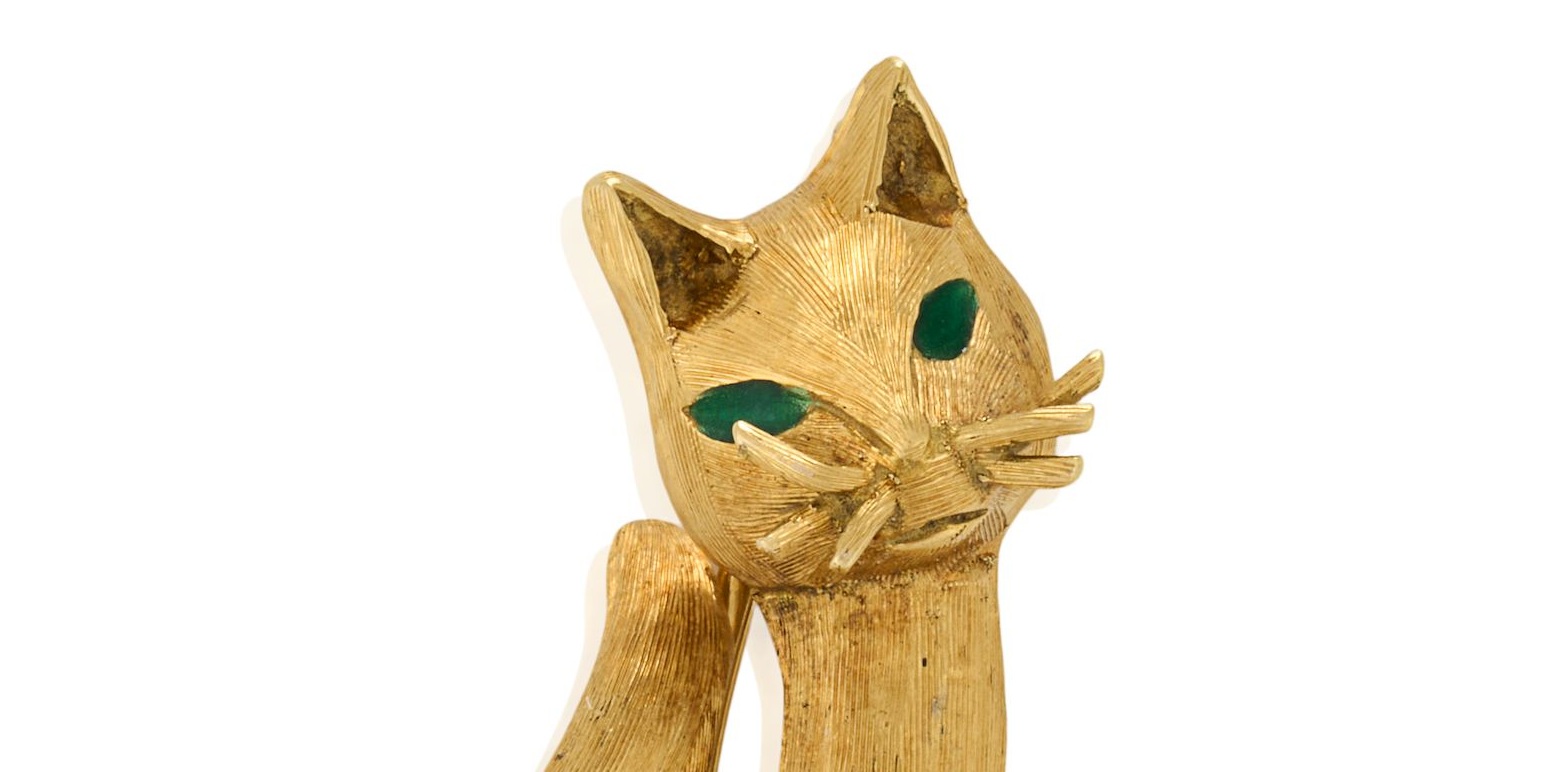
Sandy Lerner Is Rehoming Her Cats: A Tiffany Cat Brooch and Sixty-Five More
The Cisco co-founder spent four decades collecting cats in gold, enamel, amethyst and bronze. On 30 September 2026 Bonhams sells 66 of them in New York, from a $700 carved cat to a $120,000 bronze by the sculptor Rembrandt Bugatti. She is keeping the live ones.
Why Are Jewelry Prices Still Going Up?
Jewelry costs about 15% more than it did a year ago, and it is the gold accounting for most of it. The answer coming back from the jewelry trade and brands is less gold in the piece, which changes what you have to ask for at the counter.

Natural Diamond Prices Are Going Up Again, at Least for Now
Lab-grown stones pushed mined diamond prices down for years. The diamond trade's price index rose again in August, led by small stones. What that changes for you.
The newsletter.
One email when something is worth your attention. New essays, the buying calls behind them, and what we’re watching in the trade. No roundups, no affiliate dumps.