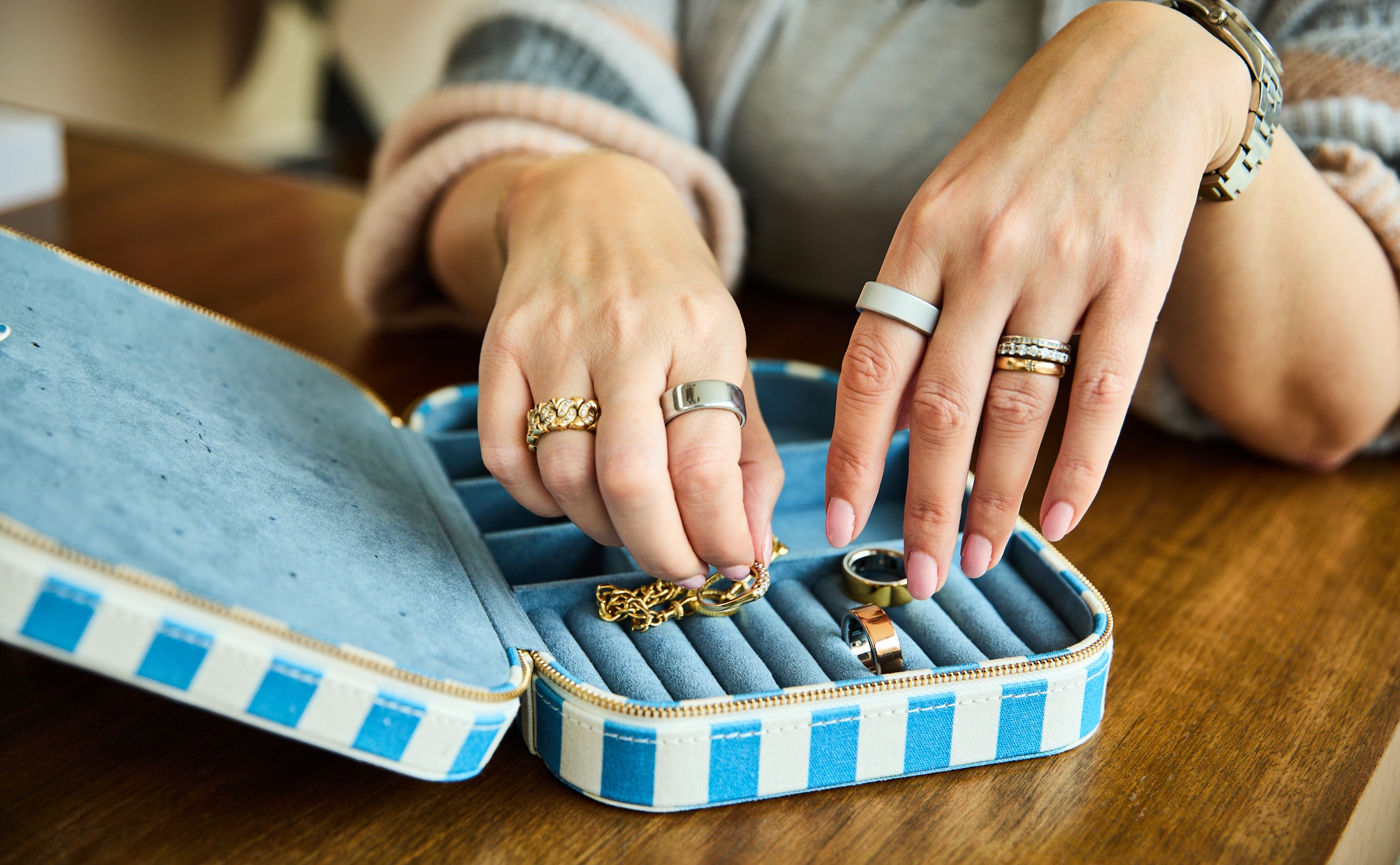
Smart Rings That Look Like Jewelry: Oura Ring 5 vs Ultrahuman Rare
The Oura Ring 5 is small enough to pass for a plain gold band, but its gold is a coating. Ultrahuman's Rare is solid 18k. Neither is quite fine jewelry, and whether either is worth it comes down to what you will trade.
A smart ring does what a fitness watch does, tracking your sleep, heart rate, and recovery, but it does it from your finger, with no screen and nothing to charge for most of a week. That trade has caught on: plenty of people who would never wear a smartwatch to bed will wear a ring, and Oura alone has sold more than five million of them, nearly three million in the last year. The newest one, the Oura Ring 5, is also the smallest yet, about six millimeters wide and two grams, small enough to sit in a stack of real rings without drawing a comment. That is the part that matters here. The pitch is now a luxury smart ring that looks like jewelry, and for a hand that already wears real gold, the honest question is whether it holds up next to the real thing.
If the sleep and recovery numbers would change what you do with your days, you are already a fitness tracker customer and I’m not going to try to convince you otherwise. If you do not care whether it reads as a gadget, buy a wrist band or smart watch, wear it as the honest tech device it is, and you are done here. For the hand that does care, the options come down to exactly three devices, each charging its own tax.
The Fine-Jewelry Bar, and Why the Options Are Only Three
The bar in play is the one your own pieces likely already clear: fine jewelry, which could be defined as solid metal all the way through, certified by a brand stamp inside the band, finish work that ages into a patina instead of failing, proportions that behave in a stack, and some reasonable permanence, the piece doesn’t necessarily need to outlast you, but it should have some staying power and holds some of its worth along the way. Plenty of real jewelry lives below these bars. Vermeil, for example, which is gold layered over sterling silver, or gold-filled, which is a sheet of gold bonded to a brass core, or the costume brooch your grandmother wore to church, all of those likely fail some of these tests. So call it the fine-jewelry standard rather than a definition of jewelry itself. You need a couple of those criteria to be filled to call something fine jewelry and a tech ring is no different.
A hand that wears hallmark branded 18k solid bands is entitled to ask whether the new tech arrival can hang in the jewelry box. The questions are the same ones behind how to tell whether fine jewelry is well made, and nothing about them changes because the newest applicant has Bluetooth in it.

Smart rings have auditioned for jewelry status before. A first wave ran from about 2014: Ringly raised $5.1 million from Andreessen Horowitz for a ring plated in 18k gold and set with semiprecious stones, WiseWear put Iris Apfel in its campaigns and its connected bracelets into Saks, and by 2018 both were gone; Motiv, which made an honest smart ring, was acquired in 2020 and stopped being a consumer product. Measured in materials, that wave carried more gold on its surfaces than today’s rings do, and it died anyway. What it never had was proportion, and proportion is the thing the Ring 5 finally solved, running roughly forty percent smaller than the ring it replaced, across the line where a ring stops reading as a device.
Judged on the full fine-jewelry bar, though, no smart ring you can buy in the US passes as fine jewelry. The gold on the mainstream rings is a coating, the finishes scratch by their makers’ own admission, and all of them run on sealed batteries with expiration dates. Those limitations are the reason the options here are essentially three and not thirty: each of the three gets you to a ring that reads as jewelry from a different direction, and each collects a different tech tax on the way.
A karat hallmark promises what the metal is all the way through, and no smart ring is going to carry one.
Option One: The Oura Ring 5 in Gold, Where the Tax Is the Coating
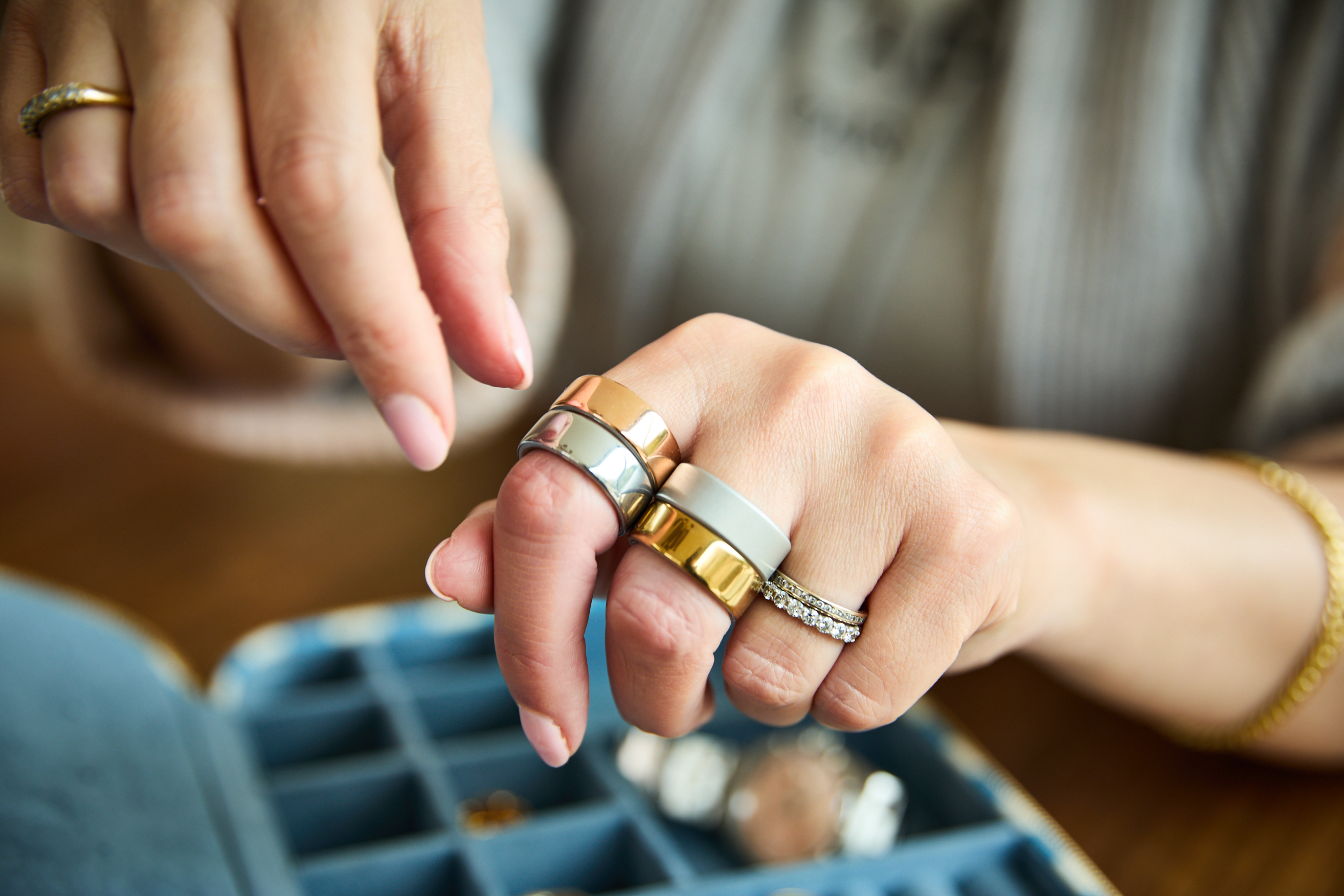
The gold tones of the Oura Ring 5 are the closest a smart ring has come so far to disappearing into a fine-jewelry stack. At ~6 millimeters wide and ~2 millimeters thick, it sits squarely among the low-dome stacking bands, the ones that run between about one and a half and three millimeters thick, and in company it reads as a plain gold band. What a jewelry stack says depends on every piece holding its look.
The tax is the coating. The Ring 5’s Gold and Deep Rose are PVD finishes, physical vapor deposition, a film of metal color measured in microns laid over the titanium body. The tone got truer this generation, but it is still a coating doing an impression of a metal the ring does not contain, and the wear shows early: owners report gold tones going shiny at the edges within the first year, and Oura’s own spec sheet says minor scratches from regular wear are normal. A jeweler would never print that sentence about a $499 band, because on solid metal a scratch is patina in progress. On a coating, a scratch is the truth coming out. Buy the gold tone knowing the year-three ring will show titanium at its edges, two millimeters from bands that will still be gold at year thirty.
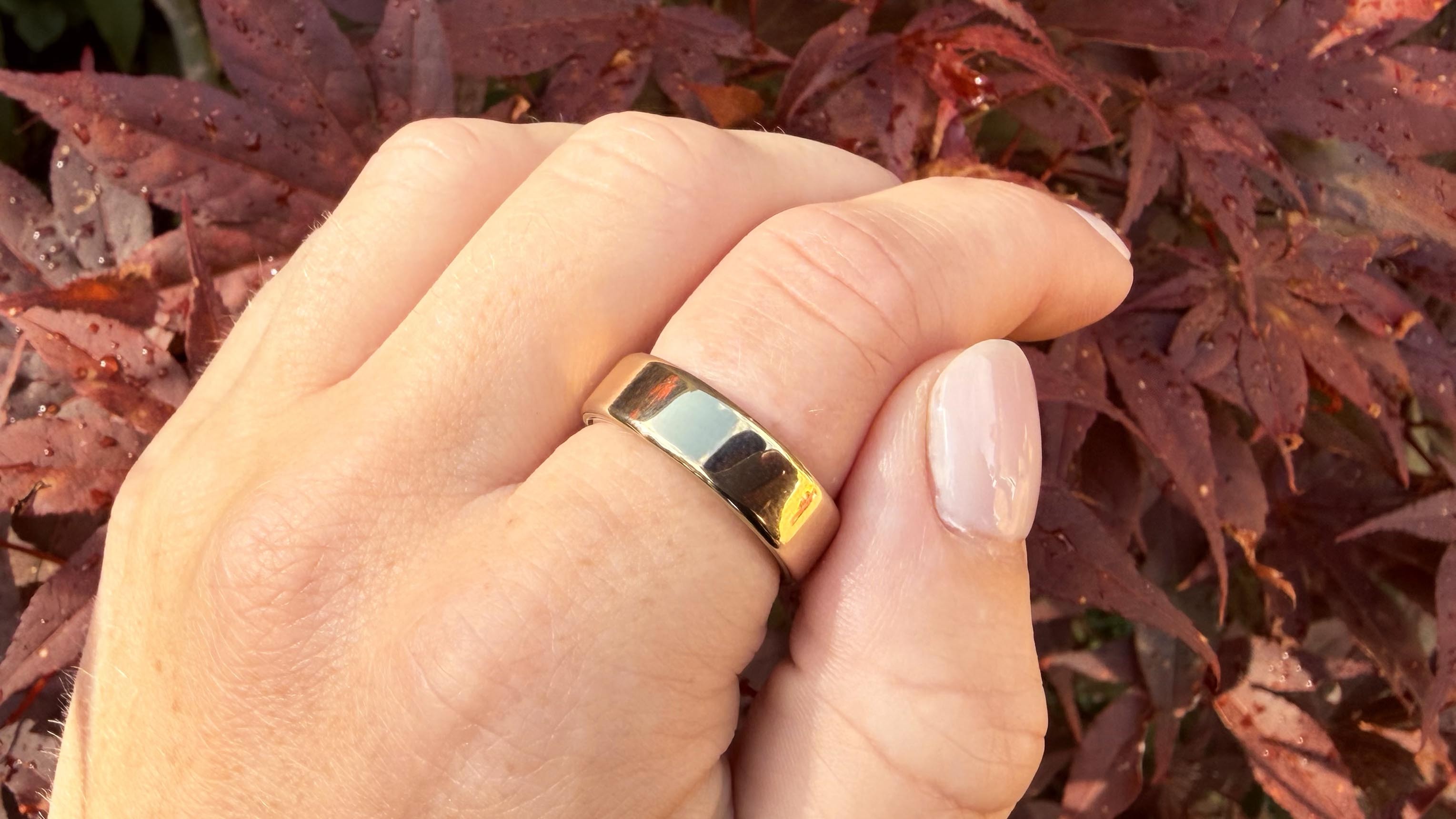
The rest of the field charges the same tax. Samsung’s Galaxy Ring is grade-5 titanium in three finishes, one of them called gold, and Ultrahuman’s Ring PRO, the $479 flagship that fought its way back into the American market this year after losing a patent case to Oura, is titanium under a coating named Bionic Gold. The closest real gold has come to a smart ring you could buy in the US was trim: the Gucci x Oura ring of 2022 carried a braided 18-karat accent on a titanium body, a monogram’s worth of gold at $950, and it sold out within weeks and has surfaced since only in limited runs.
What the coating buys is the rest of the deal: this is the only option of the three under $500, the Ring 5 is the smallest smart ring on the market by Oura’s own billing, and it is the one route a stack absorbs today.
Option Two: The Ultrahuman Rare, Where the Tax is a Patent Dispute in the US
One smart ring in the world right now mostly passes the metal test. Ultrahuman’s Rare runs 18k gold or 950 platinum on the body, gold from accredited refineries, stamped with a hallmark, because on this criterion it is jewelry. It’s solid enough on the outside, despite having circuitry and a battery inside, that it will age the way the rest of your gold ages: scratches settle into patina instead of exposing a different metal underneath, so at year three the ring reads worn in rather than worn out. And on the day it stops being smart, the gold still weighs what it weighs and sells the way scrap gold sells; a jeweler pricing one would simply ask how many grams of gold remain once the sensors and the battery have taken their share of the body.
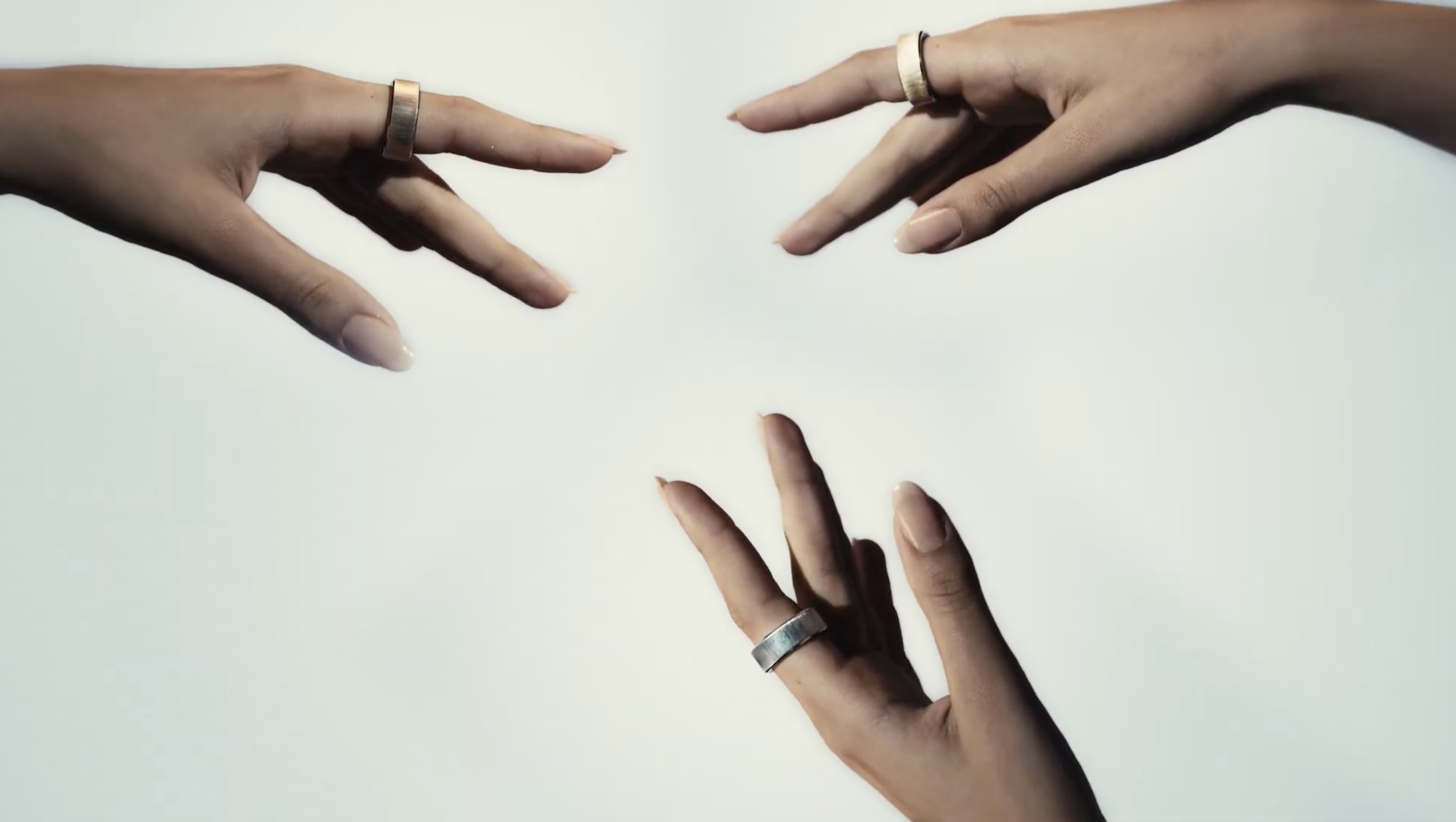
At about $1,900 in gold and $2,200 in platinum, the Ultrahuman Rare shops against real jewelry and holds the comparison. The same $1,900 buys the Gold Perch band from Arielle Ratner, solid 18k and designed to stack, and Tiffany’s plain 18k Forever band runs $1,950.
Note that the Rare in gold cannot ship to a US address, because the import ban Oura won against Ultrahuman in 2025 still applies to the solid-gold line. Ultrahuman’s titanium Ring PRO was redesigned around the patent, cleared customs, and is orderable in the US today with shipping from mid-August, so the company is back in the market. Keep your eyes out for the gold version.
Option Three: The Solid-Gold Smart Ring Enhancer, Where the Tax Is Bulk
The third option keeps the gadget and hires real gold to do the jewelry work. Gabriel & Co., a fine-jewelry house, makes solid-gold smart ring enhancers, open bands in gold with diamonds shaped to nest around the device while keeping its sensors on the skin, and independent makers on Etsy sell 14k solid-gold covers that do the same job plainer. The logic is the most honest of the three: the gold on your hand is real, the gold does the talking, and the gold is still yours after the electronics inside it are done.
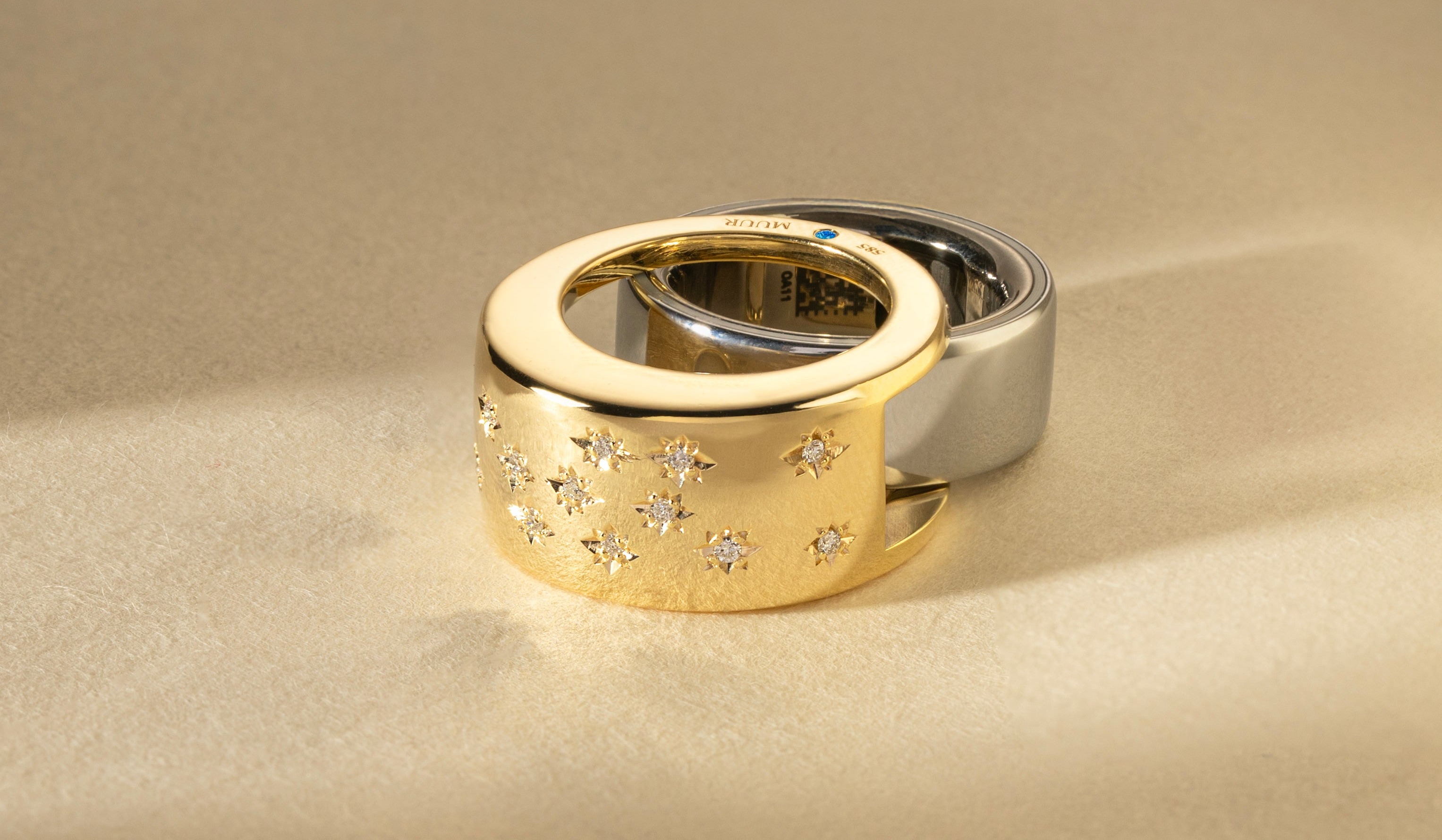
The tax is bulk. You are wearing two rings in one slot, and however finely the enhancer is made, the pairing wears bigger on the finger than either piece would alone; it is also an odd object to explain, a jacket of real jewelry for a gadget. What you get for the trade is the one version of this purchase where the jewelry money survives the device it decorates. Luckily maximalism is back in right now, so it’s easier to pull this trick off.
Every smart ring, the solid-gold Rare included, is built around a battery that cannot be replaced.
The Battery Clock: Why You Buy for Today, with Gadget Money
Whichever smart ring option you choose, it essentially arrives with an expiration date. Inside every smart ring, the solid-gold Rare included, is a small lithium battery sealed in place; iFixit’s teardown of the Oura Ring 5 described a metal-and-epoxy sandwich that cannot be opened without destroying the ring. In practice owners get roughly two to four years before the battery fades. The warranty runs one year, and a claim replaces the whole ring, because replacing the battery is impossible. Be prepared to pay to keep it connected, too. Oura charges $5.99 a month to unlock most of what its ring measures, and the company’s CEO said this year, plainly, that the paywall is not going away. Almost all used smart rings sell the way used electronics sell, on Swappa and eBay, priced by generation and dragged down by its battery, the same slide that governs lab-grown diamond resale value: whatever you paid, a newer and cheaper successor likely undercuts it. You can occasionally find the Gucci x Oura on jewelry resale sites, but it’s rare.
Just be aware you are choosing a ring for the next few years rather than the next few decades, so pay for it with gadget money, the budget that already expects a phone to retire, and keep the jewelry money for the first fine jewelry piece worth buying, or the replacement in a few years. The ring will spend its whole short life next to real jewelry, which is exactly why it is worth choosing carefully.
Where Smart Rings Go Next: Closer to Fine Jewelry
The reason to choose for today instead of holding out is that the category is moving toward you: in four years it went from a gold-trimmed collab to a hallmarked solid-gold ring to proportions that actually fit in a stack. And the patent wall that keeps the solid gold out of the American market is already coming down. RingConn, sued in the same case Ultrahuman lost, settled and pays Oura royalties to keep selling in the US; Ultrahuman redesigned its titanium ring back into the country this spring. A license or a redesign would carry gold across the same border, and one of them will. The field in a few years will be better than the one you are shopping today, but that’s the same for all tech. We’re finally past the point where it’s worth it to wait for the next generation.
So choose your weapon for today, knowing you’ll be replacing it in a few years anyway: the gold tone that will scratch, the solid gold you would have to travel outside the US to buy, or the enhancer that doubles your ring. You are allowed to buy a ring you will retire. Your solid pieces are the ones that have to last forever; this one only has to look good beside them while it lasts, and any of the three can. Wear it without apology, and trade up when the options improve.
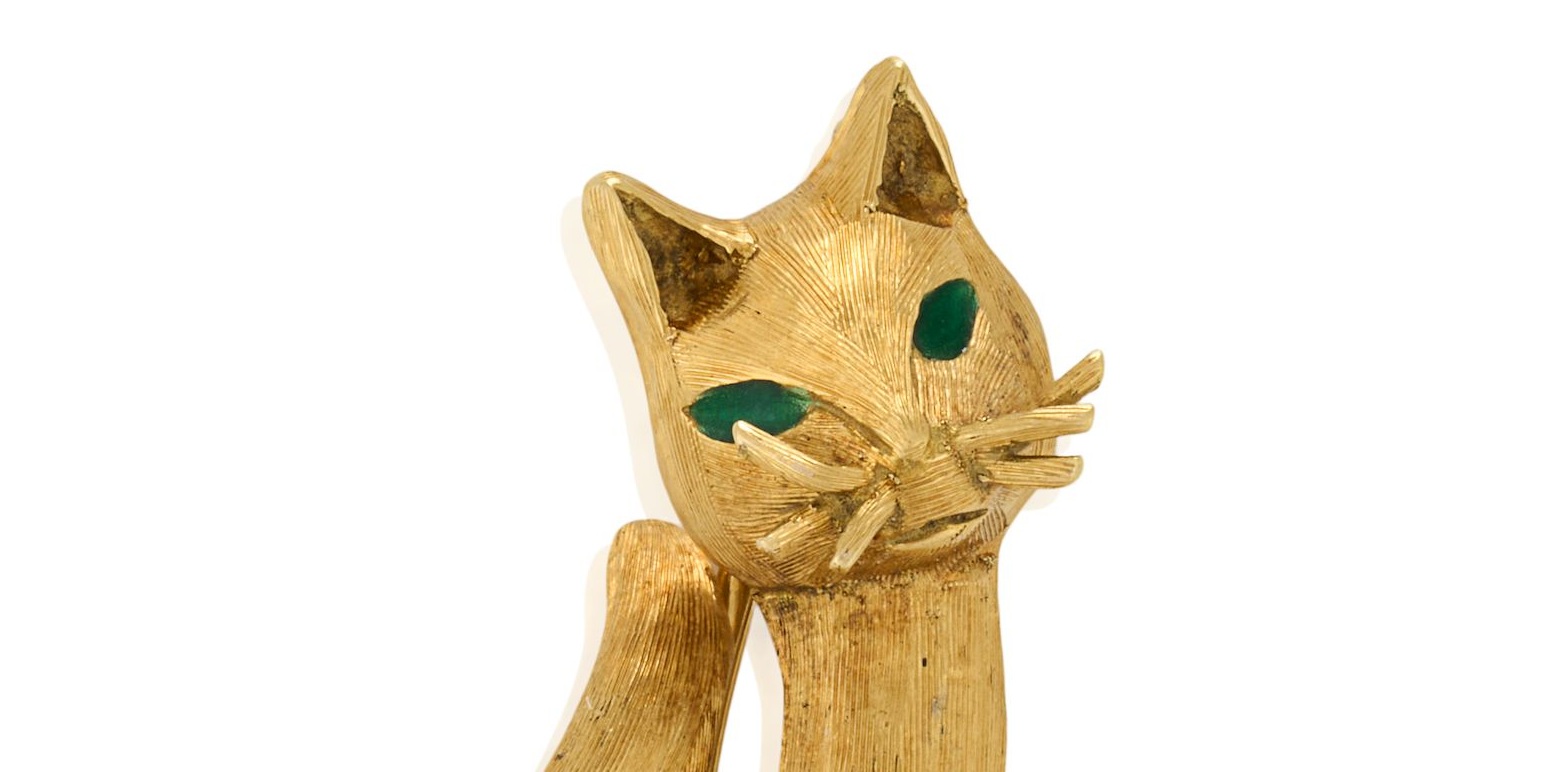
Sandy Lerner Is Rehoming Her Cats: A Tiffany Cat Brooch and Sixty-Five More
The Cisco co-founder spent four decades collecting cats in gold, enamel, amethyst and bronze. On 30 September 2026 Bonhams sells 66 of them in New York, from a $700 carved cat to a $120,000 bronze by the sculptor Rembrandt Bugatti. She is keeping the live ones.
Why Are Jewelry Prices Still Going Up?
Jewelry costs about 15% more than it did a year ago, and it is the gold accounting for most of it. The answer coming back from the jewelry trade and brands is less gold in the piece, which changes what you have to ask for at the counter.
Natural Diamond Prices Are Going Up Again, at Least for Now
Lab-grown stones pushed mined diamond prices down for years. The diamond trade's price index rose again in August, led by small stones. What that changes for you.
The newsletter.
One email when something is worth your attention. New essays, the buying calls behind them, and what we’re watching in the trade. No roundups, no affiliate dumps.