Courtesy of Material Good
How to Wear Colorful Jewelry Without Looking Cheap
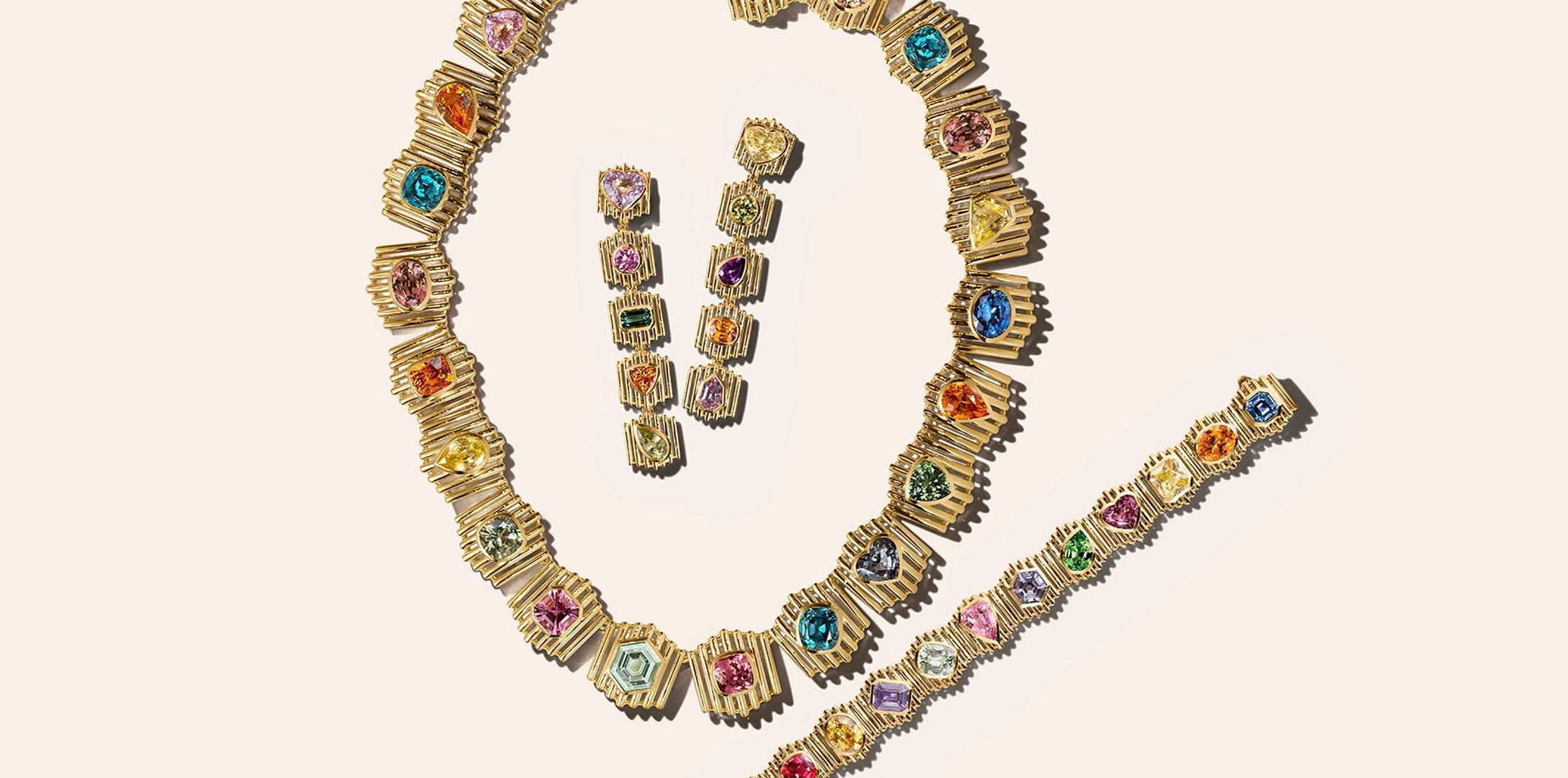
Aryna Sabalenka played the US Open in 127 carats of colored stones and none of it looked cheap. The reason is visible in the pieces: every stone set alone in plain gold, with bare metal around it. That is a rule you can use on one ring, whatever you spend.
Bold is back, and the version of it that is easy to picture is one color or none at all: heavy gold, sculptural shapes, the metal drawing the eye by itself. It’s harder to wear colorful jewelry without looking cheap, especially more than one color at once, because it usually lands somewhere between costume and gaudy. On 25 August, Aryna Sabalenka walked onto court at the US Open for a mixed-doubles match with Novak Djokovic in a little over 127 carats of colored stones. Eight different species, sapphire and garnet and tourmaline through to tanzanite and tsavorite, across a necklace, a bracelet and a pair of earrings. Material Good made the three pieces for her and calls them the Prism suite. She is the house’s first jewelry ambassador, so this was a campaign before it was an outfit. It did not look cheap, and the reason is in the pieces themselves.
Every stone sits by itself
The first thing you notice on the three pieces is the space. Each stone is bezel set, which means a thin collar of gold runs all the way round its edge, holding it, and then there is bare metal on either side before the next one. Nowhere on the necklace, the bracelet or the earrings is there a pavement of tiny stones packed edge to edge. Material Good’s own product pages describe every stone as set alone on fluted gold links, meaning links with grooves cut into them, and the word pavé does not appear once. Atara Lev, the head of design there, told JCK that the loudest suite her house has made is at heart a simple thing. “At the most basic level, this is a plain gold necklace with single gemstones. Minimal,” she said of the necklace, and what makes it feel maximal is the mix of shapes and colors, “without adding pavé, additional metal finishes, dangling elements, or anything else simply for the sake of more.”
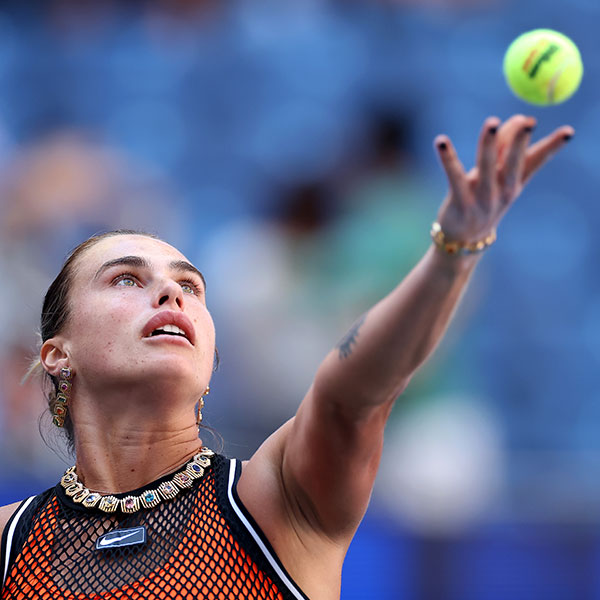
Photo: Getty Images, courtesy of Material Good
The earrings come apart. Each one is a single stud with a detachable jacket of four more stones, so the biggest earring in the suite unclips down to one stone on one ear. Five stones with room around each of them read bigger than the same gold packed with small ones would.
Crowding is what makes bold jewelry look cheap
The rule works on one ring as well as on a suite of three, and it is where the money goes too, because setting is billed by the stone.
Sorellina sells one hinged 18k gold ear cuff two ways: plain, 3 mm wide, at $1,500, and 4 mm wide with 0.23 carats of pavé at $2,800. Part of that $1,300 gap is the extra millimeter of gold. Most of it is the labor of setting a great many very small stones, which this year runs about $15 a stone for small accents against about $49 for one center stone. A simple pavé band carries hundreds of stones, so hundreds of those $15 settings are thousands of dollars of bench work, where the single center stone is $49 of it.
None of that makes one colored stone automatically the cheaper piece, because a good stone on its own can cost more than any field of pavé. What it means is that the two things are different purchases. A field of small stones buys you sparkle, and one good stone in a plain bezel buys you the color.
The same idea, one stone with plain gold around it, is available without a tournament behind it. GOODSTONE’s East West Half Bezel Solitaire holds a marquise-cut green emerald in a half bezel, a collar of gold around part of the stone’s edge rather than all of it, and starts at $2,475. If you want the stone to be a sapphire, the case for which ones is in our guide to colored sapphire fine jewelry. If you want scale without color at all, that is what maximalist fine jewelry in sculptural gold already gives you.
A matched set is not the lesson, and you are not going on court. Sabalenka’s suite is a campaign, three pieces with no published price. What carries down is the mechanism, one piece at a time: isolate the stone, keep the metal plain, leave the space. So in front of the case, look at what sits around each stone. If a good stone has room on both sides of it, the piece will hold up, whatever it cost. If the stones are packed shoulder to shoulder, what you are paying for is the setting labor and the sparkle, which is a fine thing to buy when it is the thing you wanted.
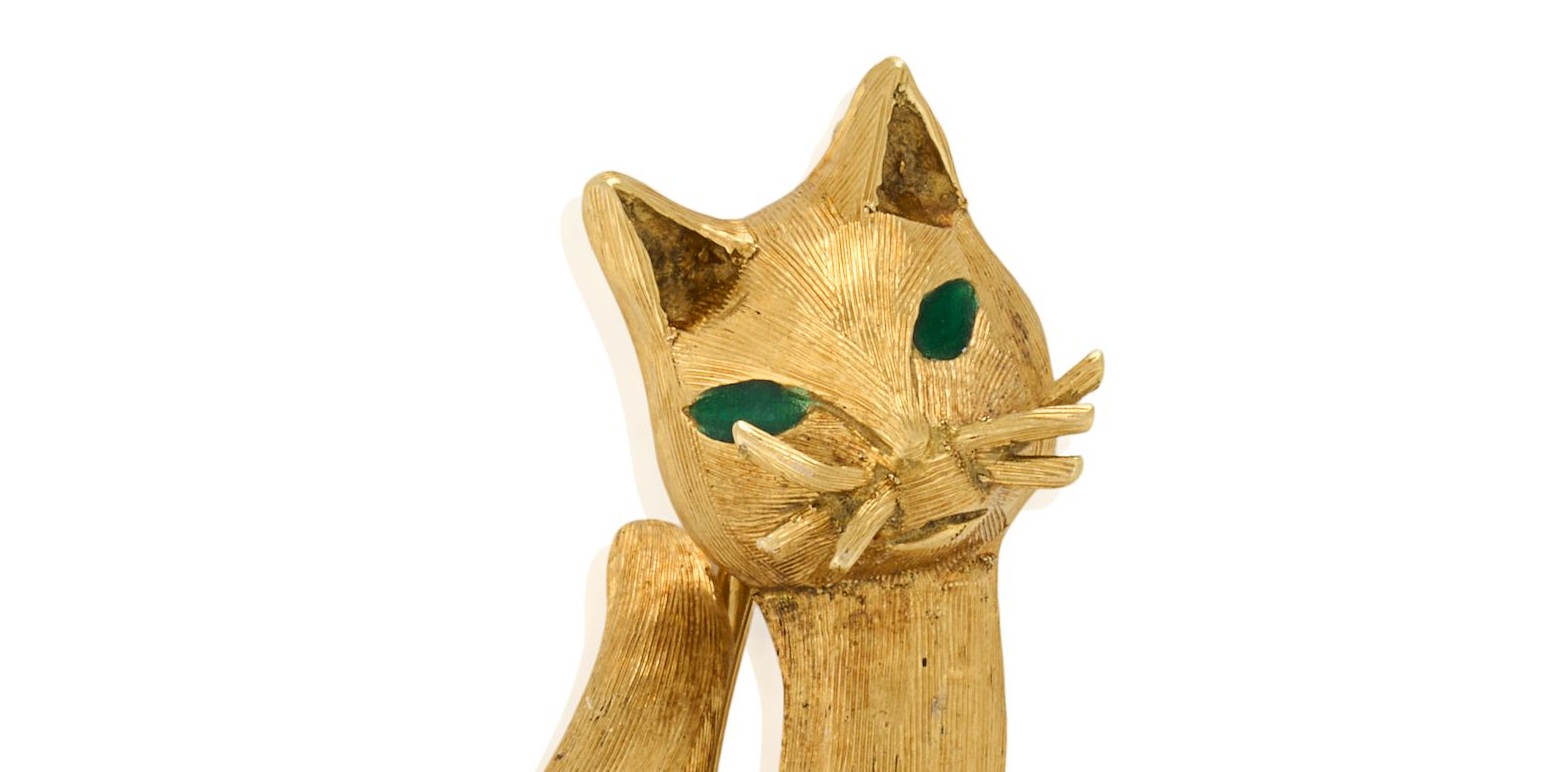
Sandy Lerner Is Rehoming Her Cats: A Tiffany Cat Brooch and Sixty-Five More
The Cisco co-founder spent four decades collecting cats in gold, enamel, amethyst and bronze. On 30 September 2026 Bonhams sells 66 of them in New York, from a $700 carved cat to a $120,000 bronze by the sculptor Rembrandt Bugatti. She is keeping the live ones.
Why Are Jewelry Prices Still Going Up?
Jewelry costs about 15% more than it did a year ago, and it is the gold accounting for most of it. The answer coming back from the jewelry trade and brands is less gold in the piece, which changes what you have to ask for at the counter.
Natural Diamond Prices Are Going Up Again, at Least for Now
Lab-grown stones pushed mined diamond prices down for years. The diamond trade's price index rose again in August, led by small stones. What that changes for you.
The newsletter.
One email when something is worth your attention. New essays, the buying calls behind them, and what we’re watching in the trade. No roundups, no affiliate dumps.